

Hi, How Can We Help You?
  • Level 3, 58 Kitchener Pde, Bankstown Sydney NSW
  • contact@emkglobal.com.au
  • (+61) 487 026 666

Tag Archives: news

July 20, 2026

Choosing between the Skilled Nominated Visa (Subclass 190) and Skilled Work Regional Visa (Subclass 491) is one of the biggest decisions for skilled migrants planning permanent residency in Australia. 

Both visas require state or territory nomination, both use the SkillSelect points system, and both can lead to Australian permanent residency. 

However, they are designed for different applicants. 

The Subclass 190 visa provides permanent residency immediately, while the Subclass 491 visa is a provisional regional visa that provides a pathway to permanent residency after meeting regional living and income requirements. 

The right choice depends on your: 

  • Points score 
  • Occupation demand 
  • State nomination availability 
  • Willingness to live in regional Australia 
  • Long-term migration goals 

This guide explains the key differences between the 190 visa vs 491 visa in 2026 and helps you decide which pathway may suit your profile. 

What Is the Subclass 190 Visa? 

The Skilled Nominated Visa (Subclass 190) is a permanent residency visa for skilled workers nominated by an Australian state or territory government. 

Once granted, applicants become Australian permanent residents. 

Key Features of the 190 Visa 

  • Permanent residency from visa grant 
  • Requires state or territory nomination 
  • Requires an Expression of Interest (EOI) through SkillSelect 
  • Provides 5 additional points for nomination 
  • Applicant must meet occupation and eligibility requirements 
  • Applicants are generally expected to live in the nominating state for a period after arrival 

The 190 visa is highly competitive because it offers immediate permanent residency. 

Many states prioritise applicants with: 

  • Higher points scores 
  • Australian study or work experience 
  • In-demand occupations 
  • Strong English ability 
  • Skills shortages matching state needs

What Is the Subclass 491 Visa? 

The Skilled Work Regional (Provisional) Visa (Subclass 491) is designed for skilled migrants who are willing to live and work in regional Australia. 

It provides a pathway to permanent residency through the Subclass 191 Permanent Residence (Skilled Regional) Visa after meeting the required conditions. 

Key Features of the 491 Visa 

  • Valid for up to 5 years 
  • Requires state/territory nomination or eligible family sponsorship 
  • Provides 15 additional points for nomination 
  • Requires living and working in a designated regional area 
  • Can lead to permanent residency through Subclass 191 

The 491 visa is often a strategic option for applicants who do not have enough points for a competitive 190 invitation. 

190 Visa vs 491 Visa: Key Differences 

Feature Subclass 190 Visa Subclass 491 Visa 
Visa type Permanent visa Provisional regional visa 
PR status Granted immediately Apply through Subclass 191 later 
Points benefit +5 points +15 points 
Regional requirement No Yes 
Living requirement State commitment Regional area commitment 
Competition Higher Generally lower 
Best suited for High-point applicants Applicants needing extra points 

The Points Difference: Why 491 Can Change Your Chances 

The biggest difference between the two pathways is the points advantage. 

The 190 visa provides: 

+5 points 

The 491 visa provides: 

+15 points 

That additional 10 points can completely change an applicant’s competitiveness. 

For example: 

An applicant with: 

  • 70 points → may struggle for 190 invitations 
  • 85 points after 491 nomination points → becomes much more competitive 

For many applicants, the 491 is not a backup option — it is the pathway that makes state nomination achievable. 

 Who Should Consider the 190 Visa? 

The Subclass 190 may be the better option if: 

  • You already have a strong points score 
  • Applicants with competitive points may have better chances of receiving invitations without needing the additional regional points. 
  • You want permanent residency immediately 
  • The biggest advantage of the 190 visa is receiving PR directly instead of transitioning from a provisional visa. 
  • Your occupation is available on state nomination lists 
  • If your occupation is actively selected by states, the 190 pathway may provide a faster route. 
  • You prefer living in metropolitan areas 
  • Although state commitments apply, the 190 provides more flexibility compared with regional obligations. 

Who Should Consider the 491 Visa? 

The Subclass 491 may suit you if: 

  • Your points score is not high enough for 190 
  • Applicants around the 65–75 point range often benefit significantly from the additional 15 points. 
  • Your occupation is available through regional pathways 
  • Some occupations have stronger opportunities through regional nomination than metropolitan state programs. 
  • You are open to regional Australia 

Regional Australia includes many attractive locations such as: 

  • Adelaide 
  • Perth 
  • Canberra 
  • Hobart 
  • Darwin 
  • Gold Coast 
  • Newcastle 
  • Wollongong 


Regional areas can offer strong employment opportunities, lower living costs, and migration pathways. 

You want more invitation opportunities 

Regional nomination programs often have different competition levels compared with major metropolitan pathways. 

Can You Apply for Both 190 and 491 Visa? 

Yes. 

Applicants can include both visa preferences in their SkillSelect Expression of Interest (EOI). 

Many applicants use a dual strategy: 

  1. Submit interest for both 190 and 491 
  1. Apply for state nomination opportunities 
  1. Accept the strongest pathway available 

This approach is common for applicants who want to maximise their chances. 

491 Visa Pathway to Permanent Residency 

Many applicants worry because the 491 is not permanent residency immediately. 

The pathway generally looks like this: 

  1. Submit EOI 
  1. Receive state nomination 
  1. Apply for Subclass 491 visa 
  1. Live and work in regional Australia 
  1. Meet eligibility requirements 
  1. Apply for Subclass 191 permanent residency 

The 491 pathway takes longer than 190, but it can provide a realistic route for applicants who cannot secure immediate PR. 

How Occupation Demand Affects Your Choice 

Your occupation is just as important as your points score. 

Different states have different priorities depending on workforce shortages. 

Commonly selected fields include: 

  • Healthcare 
  • Information Technology 
  • Engineering 
  • Construction 
  • Education 
  • Trades 
  • Community services 

Before choosing between 190 and 491, applicants should review: 

  • Current state occupation lists 
  • Invitation trends 
  • Offshore/onshore preferences 
  • Available nomination places 

Latest 2026 Considerations for Skilled Migrants 

In 2026, Australian skilled migration continues to focus on: 

  • Filling critical skills shortages 
  • Supporting regional workforce needs 
  • Selecting applicants who match state priorities 

Because invitation rounds and occupation demands change regularly, the “best” visa depends on your personal profile rather than a one-size-fits-all answer. 

Frequently Asked Questions 

  1. Is 190 better than 491? 

Not always. The 190 is better for applicants who qualify because it provides immediate permanent residency. The 491 may be better for applicants who need additional points or have stronger regional opportunities. 

  1. How many points are required for 190 and 491? 

The minimum points requirement is 65 points, but receiving an invitation depends on occupation, state demand, and competition. 

  1. Can I move to Sydney after getting a 491 visa? 

491 visa holders must live, work, or study in a designated regional area while meeting visa conditions. Moving to non-regional areas before meeting requirements may affect your pathway. 

  1. Does 491 lead to permanent residency? 

Yes. Eligible applicants may transition to permanent residency through the Subclass 191 visa after meeting requirements. 

Which visa is faster: 190 or 491? 

The 190 is generally faster because it provides PR directly. However, some applicants may receive a 491 invitation sooner due to lower competition. 


Final Verdict: 190 vs 491 Visa — Which One Should You Choose? 

Choose the 190 visa if: 

✔ You have a competitive points score 

✔ Your occupation is in demand 

✔ You want PR immediately 

Choose the 491 visa if: 

✔ You need the extra 15 points 

✔ Your occupation has stronger regional opportunities 

✔ You are willing to live in regional Australia 

For many applicants, especially those between 65–80 points, applying for both pathways is the most practical strategy. 

The best migration pathway depends on your occupation, points score, and current state nomination opportunities. Getting the right advice before applying can help you avoid wasting time on a pathway that does not match your profile. 

April 22, 2025

The United Kingdom’s most recent international education strategy was released in 2019. It set a target of attracting 600,000 overseas students by 2030 – a threshold that was reached in 2020 – and of seeing the sector reach £35 billion in economic value by 2030. A new international education strategy is expected from government later this year.

Ahead of its release comes a new report from the International Higher Education Commission, an independent group of sector experts formed with the goal of establishing “a new ‘International Education Strategy 2.0’ in partnership with the Higher Education community.” The Commission’s latest contribution to that process arrived this week in the form of a comprehensive report, Towards a Future UK International Higher Education Strategy: Resilience, Purpose and Precision.

Developed under the chairmanship of Former Universities Minister Chris Skidmore, the report is meant to provide “a roadmap for government and the sector.”

“What might that future look like?” asks Mr Skidmore in his introduction to the report. “First and foremost, it will be forward-looking and purpose-driven. We need to ensure that international higher education isn’t just about achieving significant numbers, but also aligning with Britain’s broader economic, diplomatic, and educational objectives. A successful strategy will safeguard the critical importance of UK universities and secure Britain’s position as a global leader in higher education.”

Priorities for the next strategy

The Commission sets out a wide range of recommendations for policy makers and sector leaders, all of which are underpinned by a series of strategic priorities. They include the following.

A call for long-term planning. The Commission considers the 2019 strategy’s focus on headline growth numbers an error, and highlights the need for a “coherent, long-term plan
for international education.”

The need for policy certainty. The last two years have marked a period of tumult in policy making around international students in many destinations, including the UK. The Commission calls for greater clarity around policy intent – and around the Graduate Route post-study work rights policy in particular – in order to promote sustainable growth in foreign enrolment in the UK.

Promoting policy coherence and coordination within government. The Commission calls for “a joined-up approach to policy-making” via the formation of an international strategy group within government and with delegates from the Home Office, the Foreign, Commonwealth and Development Office and the Department for Science, Innovation, and Technology.

The drive for diversification. The report argues that diversification away from the current reliance on a small number of student markets is a key aspect of a more strategic approach to recruitment. It proposes coordinated and targeted campaigns to boost student numbers from a wider range of source countries.

Telling the story of international education. “We must much more clearly communicate the significant economic and social contributions of international students and that, in almost all cases, they leave after graduation, thereby differentiating them from broader migration narratives,” adds the report.

A call for data. There are some significant reporting lags and gaps across the UK in terms of international student data. In response, the Commission calls for a public-private sector data group to speed the collection and dissemination of student data and market insights.

Source: https://monitor.icef.com/

December 10, 2024

STEM start-ups can now access accredited sponsorship.  This will help attract the workers they need to innovate.

From 7 December 2024, STEM start-ups that have received venture capital funding from a registered Early Stage Venture Capital Limited Partnership can apply to be an accredited sponsor.

Accredited sponsors receive priority processing for nominations and visa applications for:

They will continue to receive priority processing when the Skills in Demand replaces the Temporary Skill Shortage visa on 7 December 2024​.

Before we consider a start-up for accredited status we need to approve them as a standard business sponsor.

We have also strengthened the integrity of the accreditation process and will be more strictly enforcing accreditation requirements and sponsorship obligations.

From 7 December 2024 we will also update sponsorship obligations. This means that once a sponsored visa holder leaves their sponsor’s employment, the sponsor doesn’t have to ensure they only work in their nominated occupation.

Temporary employer sponsored visa holders who stop work with their sponsoring employer have up to 180 days at a time and 365 days across their entire visa grant period to:

  • find a new sponsor
  • apply for a different visa, or
  • leave Australia.
December 5, 2024

he NSW State Migration Program has announced its holiday closure schedule. The office will close at 12 noon on Friday, 20 December 2024, and reopen at 9 am on Monday, 6 January 2025. During this period, no applications will be processed, and enquiries will not be addressed.

Applicants with visas or supporting documents expiring during this closure are advised to contact skilled.migration@investment.nsw.gov.au by Wednesday, 18 December 2024. This ensures their applications can be reviewed before the office closes for the holidays.

The team at NSW Business and Skilled Migration appreciates everyone’s understanding and extends warm wishes for a safe and happy holiday season!

November 30, 2024

Skilled Migration Update: Construction Trade Occupations Prioritised for Visa Nomination

The Victorian Government has announced updates to its skilled visa nomination program for the 2024-25 period. Certain construction trade occupations will be prioritised under the Skilled Work Regional (subclass 491) and Skilled Nominated visa (subclass 190) categories.

The prioritised occupations are listed below:

ANZSCO CodeOccupation Name
331211Carpenter and joiner
331212Carpenter
331213Joiner
333111Glazier
333211Fibrous plasterer
333212Solid plasterer
334111Plumber (general)
334112Air conditioning and mechanical services plumber
334115Roof plumber
341111Electrician (general)
341112Electrician (special class)
342111Electrical lines worker
342411Cabler (data and telecommunications)
394111Cabinetmaker


Submitting a Registration of Interest (ROI)

To be considered for Victorian skilled visa nomination, eligible candidates must first submit a Registration of Interest (ROI).

Key Points:

  • The online ROI form takes less than 10 minutes to complete.
  • There is no cost to submit an ROI or nomination application.

Steps to Apply:

  1. Submit your Expression of Interest (EOI) on the Australian Government’s SkillSelect system.
  2. Complete the Registration of Interest (ROI) on the Live in Melbourne website.
  3. If invited, submit your nomination application on the Live in Melbourne portal.
  4. Once nominated, proceed to submit your visa application to the Australian Government.
August 9, 2024

The Government has expanded eligibility for work visas for partners of some students studying towards a Green List occupation.

Partners of students studying level 7 or 8 qualifications specified on the Green List, can now apply for a work visa with open conditions.

We have updated the Green List with the main Bachelor degrees and Bachelor Honours qualifications that lead to registration for certain occupations. These are occupations that have registration as a requirement instead of New Zealand Qualifications Authority (NZQA) qualifications.

This means people with student visas studying for these registration qualifications can now support their partner’s application for a Partner of a Student Work Visa.

Check the Green List appendix in the amendment circular for the eligible qualifications.

Amendment Circular 2024-14PDF 283KB

For partners who are now eligible, their dependent school-aged children can be treated as domestic students. The children can apply for a Dependent Child Student Visa so they will not have to pay tuition fees to go to school. This currently applies to anyone with a Partner of a Student Work Visa.

Bringing family if you have a student visa

Partner of a Student Work Visa

Source: https://www.immigration.govt.nz/about-us/media-centre/news-notifications/update-to-work-rights-for-partners-of-a-student

July 25, 2024

Immigration New Zealand has expanded the eligibility for work visas for partners of some foreign students in the country.

Accompanying dependants can now apply for a Partner of Student Work Visa with open work rights if their partner is studying in “a specified level 7 or 8 bachelor’s or bachelor’s (honours) degree that will lead directly to professional registration required for a Green List role.”

Green List roles are occupations that have been classified as being in high demand by the New Zealand government. They include positions in health care, STEM fields, and others.

The new policy offers a significant benefit to accompanying children of Green List-enrolled students as well in that: “For partners who are now eligible, their dependent school-aged children can be treated as domestic students. The children can apply for a Dependent Child Student Visa so they will not have to pay tuition fees to go to school. This currently applies to anyone with a Partner of a Student Work Visa.”

The news follows the recent announcement of New Zealand’s full-year enrolment figures for 2023. The country’s schools, universities, language institutes, and vocational institutions together hosted 69,135 international students last year, a 67% increase in total foreign enrolment over 2022.

This represents 60% of the international student base in 2019, when over 115,000 international students were enrolled.

For additional background, please see:

Source: https://monitor.icef.com/2024/07/new-zealand-expands-work-rights-for-accompanying-dependants-of-foreign-students/

July 25, 2024

Quality of education at Aotearoa New Zealand’s educational institutions is reflected in the latest survey by the Brazilian Educational and Language Travel Association (Belta), presented in May.  The survey was conducted between March and April 2024 with students and international education agents from all regions of Brazil. 

ENZ’s Bruna de Natale (center) with Belta leadership shows the latest issue of Belta’s annual magazine which features Aotearoa New Zealand. Photo: Belta.

According to the latest survey by Belta (Brazilian Educational & Language Travel Association), New Zealand ranks seventh on the list of preferred educational destinations for Brazilian students. The survey interviews 836 students and 569 international education agents along with companies who work in the international education sector in Brazil.  

Respondents who chose New Zealand said their choice was based on New Zealand’s excellent positions in various international rankings for quality of life, education, civil rights protection, government transparency, and women’s safety/rights. Other factors are being able to study and work during the study programme, and New Zealand’s natural beauty and cultural attractions. 

International education professionals attended the Belta survey launch event. Photo credit: Belta

According to the survey, the main objective of students participating in a study abroad program is to fulfil the dream of experiencing different countries and cultures (39.6%); the second is the interest in language studies (27.2%).  

The majority (77%) of those who said they went abroad to learn a new language chose English when travelling. The quality of education is another reason cited by respondents who chose New Zealand. All universities in New Zealand are ranked among the top 2% in the world by major international indices, such as QS World Universities and THE – Times Higher Education. 

Bruna de Natale, Education New Zealand Manapou ki te Ao (ENZ) Market Development Manager in Brazil, said, “The Belta survey is the most important source of consistently updated international education data in Brazil. It is very encouraging that Brazilians continue to perceive New Zealand as a safe, trusted and quality education to develop their academic and professional goals.,”.  

The data from the Belta Survey 2024 reinforces the international Better Life Index, which measures variables that constitute the quality of life in countries of the Organization for Economic Co-operation and Development (OECD). In this survey, New Zealand is ranked as one of the best countries in the world to live in.  

Source: https://www.enz.govt.nz/news-and-research/ed-news/nz-among-top-10-preferred-educational-destination-for-brazilian-students?utm_medium=email&_hsenc=p2ANqtz-_EMupYX9X8QPSAIR-MG61b1SNzh-RT9xSArZllLGYged_xaV33_seMhTvzb-biY-Sdq8TJxRoMiFW_8crPHDlCTcy8BA&_hsmi=316271345&utm_content=316271345&utm_source=hs_email

July 19, 2024

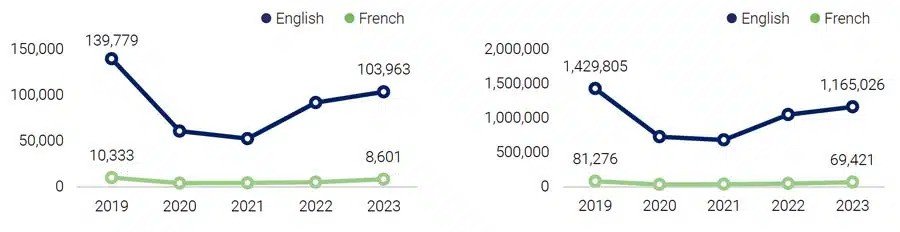
In 2023, the language training industry in Canada carried on recovering from the pandemic. According to a recent annual report from Languages Canada, which was created by industry research experts BONARD, enrollment in Canadian language courses, including English and French, was 112,564 last year, with 1,234,447 student weeks of instruction given.

That volume for 2023 is equivalent to 82% of pre-COVID student weeks and 75% of pre-pandemic student populations. Approximately 92% of those student weeks were devoted to learning the English language, with the remaining 4% being devoted to learning French. Of that total, just over 80% (83%) were provided by private providers, with state institutions running language programmes for the remaining 17%.

Students enrolled in English- and French-language training programmes in Canada, 2019–2023 (left); Student weeks delivered by English and French language training providers in Canada, 2019–2023 (right). Source: BONARD/Languages Canada

In 2023, in-person education accounted for about two thirds (63%) of all student weeks, with 30% of instruction being provided online (for both domestic and international students). The last six percentile of student weeks were delivered using a mixed methodology.

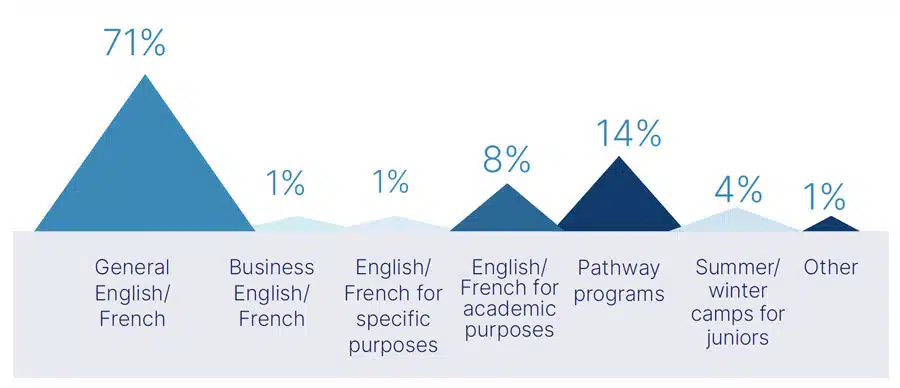
The bulk of students were enrolled in academic preparatory courses, pathway programmes, or general language study, as can be seen in the overview below.

Enrolments in language studies in Canada, by course type, for 2023. Source: BONARD/Languages Canada

Where do students come from?

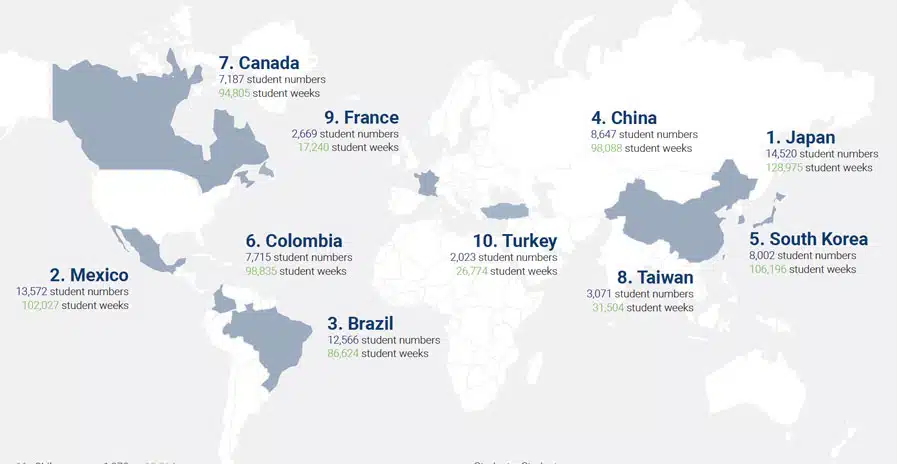
In Canada, more than three out of every four language learners (76%) are from Asia or Latin America. Highlighting the top 10 sending markets for 2023 is the infographic that follows. In 2023, all of those top sending nations saw growth over the previous year, with the exception of Colombia, which saw a -6% fall.

Top ten sending markets for Canadian language-learning programmes, 2023. Source: BONARD/Languages Canada

Visa status and visa challenges

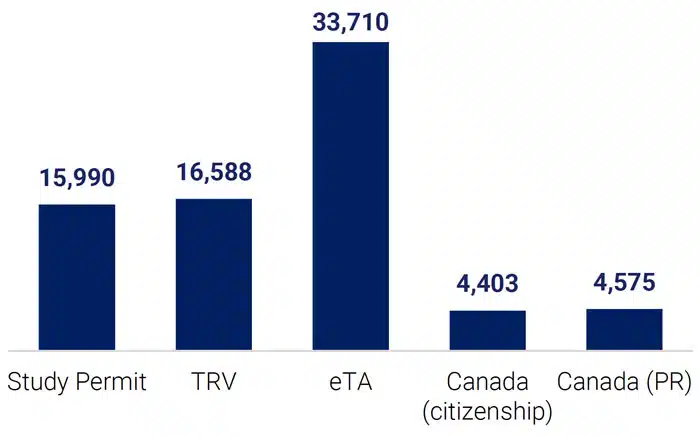
Numerous students who had a guest visa (designated as “eTA” or electronic travel authorization in the legend below) attended a Canadian language programme, according to the accompanying chart. However, a sizable portion also entered Canada via a study permit or temporary residency visa.

Student numbers by visa type, 2023. Source: BONARD/Languages Canada

The report adds that, “In 2023, the fastest-growing visa category was the Temporary Resident Visa (TRV). The number of students entering Canada through the TRV route increased from 8,559 in 2022 to 16,588 in 2023, surpassing pre-pandemic levels. This also caused a drop in the average course duration seen predominantly in the private sector. On the other hand, the number of students on study permits decreased from 17,191 in 2022 to 15,990 in 2023 due to issues with visa processing and refusals.”

As we have seen in other destinations this year, however, Canadian language schools report that visa issues prevented thousands more students from pursuing their studies in 2023. The report estimates that at least 2,671 students were not able to travel to Canada as planned due to processing delays for temporary resident visas, and that a further 4,479 students were not able to travel due to study permit delays.

This means that visa processing issues disrupted the travel plans for a minimum of 7,150 language students in 2023 – a number equivalent to 7% of the total enrolment for the year. Commenting in a foreword to the report, Languages Canada Executive Director Gonzalo Peralta said, “In 2019, Canada’s language programmes generated CDN$6.7 billion and 75,000 jobs, mostly derived from export revenues. In 2023, that figure decreased to CDN$5.5 billion and 62,000 jobs. This drop was not due to lack of opportunity, promotional efforts, or support from some areas of government, but was primarily due to immigration policy.”

Source: https://monitor.icef.com/2024/07/canadas-language-training-sector-reached-82-of-pre-pandemic-benchmark-in-2023/