

Hi, How Can We Help You?
  • Level 3, 58 Kitchener Pde, Bankstown Sydney NSW
  • contact@emkglobal.com.au
  • (+61) 487 026 666
September 19, 2026

The Australian Department of Home Affairs has confirmed that the next invitation round for the Skilled Independent visa (subclass 189) is expected to be held by 30 September 2026. 

The announcement is an important update for skilled migration applicants who currently have an active Expression of Interest (EOI) in SkillSelect or are preparing to submit one. 

Home Affairs has also specifically reminded applicants to ensure their EOI is up to date and that all information provided is accurate ahead of the upcoming invitation round. 

Next Subclass 189 Invitation Round Expected by 30 September 2026 

According to the Department of Home Affairs: 

“The next invitation round for the Skilled Independent (subclass 189) visa is expected to be held by 30 September 2026.” 

Importantly, this does not mean that the invitation round has been confirmed for 30 September itself. 

The wording “by 30 September 2026” means the Department expects the next subclass 189 invitation round to take place on or before that date. 

At this stage, Home Affairs has not published the exact date of the upcoming round, the number of invitations that will be issued or the invitation scores for individual occupations. 

Applicants should therefore avoid relying on unofficial predictions regarding invitation numbers or minimum points. 

What Is the Skilled Independent Visa (Subclass 189)? 

The Skilled Independent visa (subclass 189) is a permanent skilled migration visa for eligible skilled workers. 

Unlike the Skilled Nominated visa (subclass 190), subclass 189 does not require nomination from an Australian state or territory. It is also not an employer-sponsored visa. 

To be considered for an invitation, applicants must first submit an Expression of Interest through SkillSelect. 

SkillSelect is the Australian Government’s online system used by skilled workers to express their interest in applying for skilled migration visas, including subclasses 189, 190 and 491. 

How Does the Subclass 189 Invitation Process Work? 

Applicants seeking a subclass 189 visa must first meet the relevant eligibility requirements and submit an EOI through SkillSelect. 

Information provided in the EOI may include an applicant’s: 

  • age; 
  • English language proficiency; 
  • educational qualifications; 
  • skilled employment experience; 
  • Skills Assessment; and 
  • other information relevant to their points score. 

SkillSelect then provides an indicative points score based on the information entered by the applicant. 

An EOI is not a visa application. Applicants must receive an invitation before they can lodge a subclass 189 visa application. 

Is 65 Points Enough to Receive a Subclass 189 Invitation? 

Subclass 189 is a points-tested visa. 

Home Affairs confirms that applicants for subclasses 189, 190 and 491 must meet or exceed the minimum points threshold of 65 points. 

However, achieving 65 points does not guarantee an invitation. 

Invitation outcomes can be competitive, and the points required to receive an invitation may be higher than the minimum threshold. 

Applicants should therefore distinguish between: 

Minimum points threshold: 65 points 

and 

Points required to receive an invitation: This can vary and is not guaranteed simply by reaching 65 points. 

Home Affairs has not yet announced the invitation scores for the upcoming subclass 189 round expected by 30 September 2026. 

What Should Applicants Do Before the Next 189 Invitation Round? 

Home Affairs has specifically advised applicants to ensure their EOI is current and that all information provided is accurate. 

Applicants who already have an EOI in SkillSelect should review it carefully before the upcoming invitation round. 

An EOI can generally be updated before an invitation is received if an applicant’s circumstances change. 

Home Affairs specifically advises applicants to update their EOI if they have: 

  • gained new work experience; 
  • received a higher educational qualification; 
  • improved their English language proficiency; 
  • obtained a new Skills Assessment; or 
  • experienced a change in family circumstances. 

These changes may affect an applicant’s points score and potentially their competitiveness for an invitation. 

Check Your Skills Assessment and Employment Claims 

A valid Skills Assessment is an important part of the EOI process. 

Before submitting an EOI, applicants generally need to obtain a Skills Assessment in their nominated occupation from the relevant Australian assessing authority. 

Applicants should also carefully review the employment information included in their EOI. 

Home Affairs requires applicants to provide details of their work history, including their position, employer, employment dates and whether the employment was related to their nominated occupation. 

Applicants should ensure that any points claimed can be supported by appropriate evidence if they later receive an invitation and proceed with a visa application. 

How Long Does an EOI Remain Active? 

An EOI generally remains active in SkillSelect for two years from the date it is submitted. 

During this period, applicants can update their EOI before receiving an invitation. 

However, once an applicant has received an invitation to apply for a visa, the EOI can no longer be updated. 

Applicants with an older EOI should therefore check that it remains active and that all information reflects their current circumstances. 

What Happens If You Receive a Subclass 189 Invitation? 

If an applicant receives an invitation through SkillSelect, Home Affairs provides 60 days from the date of invitation to complete and submit the visa application online. 

This makes preparation before an invitation particularly important. 

Applicants should ensure that the information and points claimed in their EOI can be supported by the documents required for the visa application. 

An invitation itself does not automatically result in a visa grant. The applicant must still lodge a valid visa application and satisfy the applicable subclass 189 requirements. 

Has Home Affairs Announced the Occupations or Invitation Scores? 

No. 

At the time of publication, Home Affairs has confirmed the expected timing of the next subclass 189 invitation round but has not announced: 

  • the exact invitation date; 
  • the total number of invitations to be issued; 
  • which occupations will receive invitations; or 
  • the invitation score for each occupation. 

Applicants should therefore be cautious about online predictions regarding expected invitation points or occupations. 

Official invitation outcomes should be assessed once they are released by the Department of Home Affairs. 

What Should Subclass 189 Applicants Do Now? 

With the next subclass 189 invitation round expected by 30 September 2026, applicants should use this period to review their SkillSelect profile carefully. 

In particular, applicants should ensure that: 

  • their EOI remains active; 
  • all information in the EOI is accurate; 
  • their Skills Assessment details are current; 
  • English language results are correctly recorded; 
  • employment experience has been updated; 
  • educational qualifications are correctly entered; and 
  • any changes in personal or family circumstances have been reflected where required. 

Applicants should not increase their claimed points unless they genuinely meet the relevant criteria and can provide evidence to support those claims. 

Need Assistance with Subclass 189 Skilled Migration? 

The upcoming subclass 189 invitation round may present an important opportunity for eligible skilled migration applicants. 

However, receiving an invitation depends on a range of factors, including occupation eligibility, Skills Assessment, points and the information recorded in SkillSelect. 

EMK Global Education & Migration can assist with Skills Assessment, points review, EOI preparation and skilled migration pathways, including subclasses 189, 190 and 491. 

Contact EMK Global for an assessment of your circumstances and available skilled migration options. 

Disclaimer: This information is provided for general information and educational purposes only. It does not constitute immigration or legal advice. Visa requirements and policies may change, and individual circumstances vary. Please seek advice from a registered migration agent or qualified professional before making any visa or immigration decisions. 

Source: Department of Home Affairs 

September 14, 2026

Sydney, NSW, Australia — January 2026 — In the most recent and dramatic development in Australian skilled migration, the New South Wales (NSW) Government surprised thousands of hopeful visa applicants when it opened and then abruptly closed nomination Pathway 1 and Pathway 3 for the Subclass 491 Skilled Work Regional Visa — all within the same day.  

This sudden closure — occurring just hours after the portal went live — has triggered intense reaction from applicants globally and sparked urgent discussions on eligibility, preparation, and long-term strategy for Australian regional skilled migration.  

What Happened? Fast-Closing Nomination Pathways 

On 19 January 2026, NSW officially opened the nomination streams for: 

  • Pathway 1 – Work in Regional NSW: aimed at skilled workers already living and working in designated regional NSW areas in a 491-eligible occupation; and 
  • Pathway 3 – Regional NSW Graduate: designed for recent graduates from a regional NSW institution with qualifications related to an eligible occupation.  

Within less than six hours, both pathways were closed to new applications after the available nomination slots were filled.  

According to migration industry reports, NSW nomination spots were reached in a matter of hours — not days or weeks — highlighting the eye-watering demand for regional skilled places and the extremely competitive nature of the current program year.  


Why the Swift Closure? 

  1. Fixed Annual Quotas

NSW operates on a fixed allocation of nomination places for the Skilled Work Regional (Subclass 491) visa in each program year. Once these places are taken, the nomination round automatically closes — even if the closure happens within hours.  

This system ensures that nomination limits are not exceeded, but in high-demand categories the result can be abrupt closures with little advance warning. 

  1. Extremely High Demand

The latest round exposed a reality many applicants feared: demand far outstrips supply. Skilled workers across engineering, health, construction, IT, and other priority sectors rushed to apply. Migration advisers say that many applicants were not prepared with complete documentation when the portal opened — a critical factor in missing the short nomination window.  

  1. Documentation Readiness Gap

Expert commentary now notes that skills assessments, English test results, salary evidence and other documents must be fully ready before pathways open — because future openings could last only hours.  

What This Means for Applicants 

Pathways Closed for 2025–26 Program Year 

Both Pathway 1 and Pathway 3 are now closed for the remainder of the current program year. There will be no further opportunity to submit a nomination application under these streams until the next annual allocation becomes available, likely in the next program year when the NSW Government announces openings again.  

Applicants in Australia and offshore alike who intended to lodge but were unable to now must wait until the next round — which could be many months away — and re-prepare their documentation accordingly. 

Preparation Is Now Critical 

Migration specialists are advising visa seekers to: 

  • Ensure all documentation is complete and valid well in advance of any future opening; 
  • Track official NSW nomination announcements closely; and 
  • Consider Pathway 2 — if eligible — which may open later and targets applicants with Expressions of Interest (EOI) listing an occupation on the NSW Regional Skills List.  

Impact on Employers and Recruiters 

For employers in regional NSW sectors struggling to fill skill gaps, the rapid closure creates additional recruitment pressures. Many employers had hoped to secure staff through Pathway 1, which supports those already employed in NSW regional roles. Instead, they may now need to explore alternative migration pathways or skills shortages schemes to stay competitive.  


Understanding Pathways 1 & 3 — Eligibility Overview 

To fully grasp the impact of the closure, here’s a quick look at what these pathways required: 

Pathway 1 – Work in Regional NSW 

This stream was for applicants: 

  • Already employed in an eligible occupation in regional NSW; 
  • With adequate earnings (meeting the Temporary Skilled Migration Income Threshold); and 
  • Meeting all NSW criteria at the time of application.  

It was especially attractive to onshore workers seeking to formalise their nomination without offshore competition. 

Pathway 3 – Regional NSW Graduate 

This stream targeted: 

  • Recent graduates (Bachelor, Master’s or PhD) from a regional NSW university; 
  • With qualifications closely aligned to an eligible occupation; and 
  • Who met standard points and skills/English requirements.  


What’s Next for Skilled Applicants? 

Next Program Year Opens 

NSW is expected to announce a new round of nomination places for the 2026–27 program year, likely mid-year when federal allocations are known. Skilled migrants should: 

  • Update or lodge EOI in SkillSelect; 
  • Ensure all supporting documents remain current; 
  • Watch official NSW and federal migration announcements for opening dates; and 
  • Consider alternative visa options — such as other state nomination programs or the Skills in Demand (SID) visas.  

Alternative Migration Pathways 

Applicants could also explore: 

  • Subclass 190 Skilled Nominated Visa — which may have broader nomination places; 
  • Other state/territory nomination programs with different quotas and pathways; and 
  • Employer-sponsored options — where applicable. 

Why This Matters for Australia 

This flash closure isn’t just an administrative hiccup — it reflects broader pressures in Australia’s skilled migration system: 

  • High demand from global skilled workers chasing regional opportunities; 
  • Increasing competition for limited nomination places; and 
  • A clear signal that readiness and strategy are critical for future migration success. 

Final Thoughts 

The closure of NSW Subclass 491 Pathway 1 and Pathway 3 within hours is one of the most talked-about developments in the skilled migration space in early 2026. For many hopeful applicants, it was a frustrating reminder that timing, preparation, and documentation readiness can be as important as eligibility itself. 

If you’re planning to apply under NSW nomination again — whether for Subclass 491 or other streams — start preparing now. Keep skills assessments, English test results and all required documents valid and updated. Program windows may be short, but with readiness you’ll be better positioned to succeed when the next opportunity arises.  

September 14, 2026

Significant changes to teacher registration requirements in New South Wales (NSW) will take effect from 1 January 2026, directly impacting certain pathways into early childhood teaching. These updates are important for domestic and international students planning to study Early Childhood Education (ECE) in Australia, particularly those considering the Graduate Diploma pathway. 

What Is Changing in Early Childhood Education from 1 January 2026? 

From 1 January 2026, students who: 

  • Do not hold an undergraduate degree, and 
  • Enter the Graduate Diploma of Education (Early Childhood) based on five years of early childhood education and care (ECEC) work experience 

will no longer be eligible for teacher registration in NSW. 

This change applies only to teacher registration requirements in NSW and does not impact course accreditation status. 

Important Clarification: Course Accreditation Remains the Same 

The Graduate Diploma of Education (Early Childhood) remains an ACECQA-approved qualification across Australia. 

This means: 

  • The course is still recognised as a valid early childhood teaching qualification. 
  • Accreditation standards under ACECQA are unchanged. 
  • The change only affects NSW teacher registration eligibility, not the validity of the qualification itself. 

Students intending to work outside NSW may not be affected, as teacher registration rules differ across Australian states and territories. 


What Is NOT Changing? 

Several important aspects remain unchanged after 1 January 2026: 

  1. Students with aBachelor’s DegreeAre Not Affected 

Students entering the Graduate Diploma with a recognised three- or four-year bachelor’s degree remain eligible for teacher registration in NSW. 

  1. Four-Year Equivalent Qualification Still Accepted

A combination of: 

  • A 3- or 4-year bachelor’s degree, plus 
  • A Graduate Diploma in Early Childhood 

will continue to meet the four-year qualification requirement for NSW teacher registration. 

  1. No Retrospective Impact

Students who commence their studies before 1 January 2026 will not be affected by the new regulation. 

  1. Current Students Can Continue

Anyone who has already started their program before the deadline can complete their qualification under the existing rules. 


Who Is Impacted by the 2026 Early Childhood Changes? 

The impact is limited but significant for a specific group: 

  • Primarily domestic Australian students 
  • Those entering via the Diploma + 5 years work experience pathway 
  • Students without a formal undergraduate degree 

According to institutional estimates, this change affects approximately 4% of Australian students in the program. 

Are International Students Affected? 

In most cases, international students are not impacted, as they typically hold an undergraduate degree before entering a Graduate Diploma program. 

However, all students are advised to confirm registration requirements with the relevant state authority before enrolling. 


Employer-Level Changes: Additional Considerations 

In addition to NSW teacher registration changes, some early childhood employers are introducing stricter hiring standards. 

For example, certain employers are no longer accepting: 

  • A non-education bachelor’s degree 
  • Combined with a one-year qualification pathway 

It is important to understand that these employer-specific requirements are separate from: 

  • Teacher registration regulations 
  • Course accreditation standards 

Students should review employer expectations in addition to registration requirements. 


Why These Changes Matter 

The early childhood sector in Australia continues to evolve due to: 

  • Workforce quality reforms 
  • Increased professional standards 
  • Government policy updates 
  • Growing demand for qualified early childhood teachers 

NSW is strengthening qualification pathways to ensure alignment with long-term professional standards. 

For students, this means careful course planning is now more important than ever. 


Strategic Advice for Future Early Childhood Students (2026 and Beyond) 

  1. Confirm State Registration Requirements

Teacher registration rules vary between NSW, Victoria, Queensland, Western Australia, and other territories. 

  1. Prioritise a Bachelor’s Degree Pathway 

Students planning to work in NSW should strongly consider entering with a recognised undergraduate degree. 

  1. Seek Professional Academic Guidance

Consult education advisors or migration experts before enrolling. 

  1. Consider Long-Term Career Location

If planning to work outside NSW, registration rules may differ. 


Impact on the Australian Early Childhood Sector 

Despite these changes, the early childhood education sector remains one of the most in-demand professions in Australia. 

Key sector advantages include: 

  • Strong employment growth 
  • Government funding and workforce initiatives 
  • Opportunities in metropolitan and regional areas 
  • Pathways to leadership and centre director roles 
  • Potential regional migration benefits 

The 2026 changes represent regulatory refinement—not a reduction in opportunity. 


Frequently Asked Questions (FAQ) 

  1. Is the Graduate Diploma of Education (Early Childhood) still valid? 

Yes. The qualification remains ACECQA approved and nationally recognised. 

  1. Does this change apply across Australia? 

No. The change applies only to NSW teacher registration requirements. 

  1. Are current students affected? 

No. Students who commence before 1 January 2026 are not impacted. 

  1. Should international students be concerned? 

Generally no, as most international students hold an undergraduate degree prior to entry. 


Final Thoughts 

The Early Childhood Education changes from 1 January 2026 in NSW highlight the importance of understanding teacher registration requirements before enrolling in a qualification. 

While the adjustment affects a small group of students, proper academic planning ensures a smooth pathway into the early childhood profession. 

For students considering early childhood education in Australia in 2026 and beyond, early consultation and qualification verification will be key to long-term success. 

September 11, 2026

Migration Tasmania has released its latest update on processing times, Registrations of Interest (ROIs) and nomination applications under the 2026–27 Tasmanian Skilled Migration Program. 

On 10 September 2026, a total of 66 ROIs were invited to apply for state nomination, including 40 invitations for subclass 190 and 26 invitations for subclass 491.  

The latest update also provides important information on the lowest ROI scores invited, the number of ROIs currently on hand and the remaining nomination places available.
Tasmania Invitation Round – 10 September 2026 

Source: Migration Tasmania, updated 10 September 2026. 

Important: The scores published by Migration Tasmania relate to its ROI ranking system and should not be confused with the federal SkillSelect Points Test. 


66 Invitations Issued in the Latest Round 

In the invitation round conducted on 10 September 2026, Migration Tasmania invited: 

Subclass 190 – 40 invitations 

  • 6 Gold invitations  
  • 34 Green invitations  

Subclass 491 – 26 invitations 

  • 3 Gold invitations  
  • 23 further invitations  

This brings the total number of invitations issued in this particular round to 66. 

Lowest ROI Scores Invited 

The lowest scores invited on 10 September were: 

  • Subclass 190: 502 points  
  • Subclass 491: 74 points  

These figures represent the lowest ROI scores that received an invitation in this particular round. They should not be treated as fixed minimum scores or guaranteed invitation thresholds for future rounds. 

Invitation outcomes can vary between rounds depending on the number of ROIs on hand, candidate rankings, priority attributes and the availability of nomination places. 


How Many ROIs Are Currently on Hand? 

Following the 10 September invitation round, Migration Tasmania reported: 

  • 890 ROIs on hand for subclass 190  
  • 603 ROIs on hand for subclass 491  

These figures refer to ROIs with a status of “Submitted” after the invitation round had taken place. 

The number of ROIs on hand provides an indication of the level of interest in Tasmania state nomination, but an applicant’s competitiveness will depend on their individual circumstances and ranking within the relevant pathway. 

1,750 Nomination Places Remain Available 

As at the latest update, Migration Tasmania reported: 

  • 1,018 nomination places available for subclass 190  
  • 732 nomination places available for subclass 491  

This means a combined 1,750 nomination places remained available across the two visa subclasses at the time of the 10 September update. 

While a substantial number of places remain available, applicants should not interpret this as a guarantee that an ROI will receive an invitation. 

Tasmania continues to rank ROIs and issue invitations according to its program requirements and priority settings. 


Nomination Applications and Outstanding Invitations 

Migration Tasmania also provided an update on applications currently progressing through the nomination process. 

There were: 

  • 8 subclass 190 nomination applications lodged but not yet decided  
  • 13 subclass 491 nomination applications lodged but not yet decided  

In addition, invitations had already been issued but nomination applications had not yet been lodged for: 

  • 66 subclass 190 applicants  
  • 58 subclass 491 applicants  

The oldest nomination application lodged but not yet allocated to a case officer was dated 9 September 2026. 

Understanding the 536 and 86 Point Figures 

The latest update separately reports the “Lowest point score required to gain nomination (at assessment)” as: 

  • Subclass 190: 536 points  
  • Subclass 491: 86 points  

These figures are not the lowest scores invited in the 10 September round. 

Migration Tasmania specifically states that this measure is: 

“a rolling three-month average of the lowest point score resulting in an invitation.” 

Therefore, applicants should distinguish between: 

Lowest score invited on 10 September 2026 

  • 190: 502  
  • 491: 74  

and: 

Lowest point score required to gain nomination (at assessment) – rolling three-month average 

  • 190: 536  
  • 491: 86  

Neither set of figures should be interpreted as a guaranteed future invitation threshold. 


What Should Tasmania 190 and 491 Applicants Do? 

Applicants who have submitted or are preparing a Tasmania ROI should ensure that their information is accurate and that any points or priority attributes claimed can be supported by appropriate evidence. 

In particular, applicants should review their: 

  • eligible Tasmania nomination pathway;  
  • ROI score and priority attributes;  
  • Skills Assessment;  
  • English language results;  
  • employment and income evidence, where applicable; and  
  • supporting documents required for nomination.  

Invitation results can change from one round to another, so applicants should consider their overall competitiveness rather than relying solely on the lowest score published in a previous invitation round. 


Need Assistance with Tasmania State Nomination? 

The latest invitation round confirms that Tasmania continues to actively process ROIs and issue invitations for both subclass 190 and subclass 491, with 1,750 nomination places still available as at the 10 September 2026 update. 

However, Tasmania’s ROI ranking system and nomination requirements can vary depending on an applicant’s pathway and individual circumstances. 

EMK Global Education & Migration can assist with eligibility assessment, Skills Assessment, ROI preparation and Tasmania state nomination pathways for subclass 190 and subclass 491. 

Contact EMK Global for an assessment of your circumstances and available skilled migration options. 

Disclaimer: This information is provided for general information and educational purposes only. It does not constitute immigration or legal advice. Visa requirements and policies may change, and individual circumstances vary. Please seek advice from a registered migration agent or qualified professional before making any visa or immigration decisions. 

Source: Migration Tasmania  

September 8, 2026

The Australian Government has announced significant changes affecting the BSB80120 Graduate Diploma of Management (Learning) (GDML) for international students. 

The Assistant Minister for International Education has made a legislative instrument to suspend and cancel the CRICOS registration of the GDML under the Education Services for Overseas Students Act 2000 (ESOS Act).  

The key date for affected students is 5 October 2026. 

From this date, CRICOS providers will no longer be able to issue new Confirmations of Enrolment (CoEs), enrol new overseas students, or commence overseas students who have not already commenced the GDML. Students who commence the course before 5 October 2026, however, may continue studying and complete their course. 

What Is Changing from 5 October 2026? 

From 5 October 2026, all providers delivering the GDML must stop offering the course to new international students at all locations. 

For providers with no overseas students who have commenced the GDML by the deadline, CRICOS registration for the course will be automatically cancelled. 

Where a provider has international students who have already commenced by 5 October, its GDML registration will instead be suspended. Existing students can continue their studies, but no new overseas students can enrol or commence. Once those existing students have completed or withdrawn, the provider’s registration for the course will be automatically cancelled.  

Importantly, the measure applies to the course’s CRICOS registration for overseas students. Providers may continue delivering the GDML to domestic students where they remain appropriately approved under the relevant VET regulatory framework.  


Why Is the Government Cancelling the GDML’s CRICOS Registration?
 

According to the Department of Education, the Government has identified significant and systemic integrity concerns associated with the GDML. 

These concerns relate to: 

  • enrolment patterns;  
  • student transfers;  
  • non-commencement;  
  • completion outcomes; and  
  • potential Student visa integrity risks.  

The Government states that the action is intended to protect overseas students, strengthen confidence in Australia’s international education sector and help safeguard the integrity of the Student visa system.  

The legislative instrument commenced on 5 September 2026, while the key restrictions affecting new overseas students take effect from 5 October 2026. 

What Happens to Students Who Have Already Commenced? 

International students who commence the GDML before 5 October 2026 can continue studying and complete the course if they choose to do so. 

Providers must continue to meet their obligations under the ESOS framework while delivering the course to these students.  

Therefore, the Government’s decision does not mean that students who have already commenced the GDML must stop studying.

What Happens If You Have Not Commenced by 5 October 2026? 

Students who have not commenced the GDML by 5 October 2026 will not be able to commence the course. 

Importantly, CoEs issued to students who have not commenced will also be cancelled on 5 October 2026. 

Providers are expected to contact affected students as early as possible to discuss their available options. This also includes students whose packaged study arrangements contain the GDML.  

Students holding a future GDML CoE should therefore review their circumstances promptly rather than assuming that an existing CoE will allow them to commence after the deadline.

What Should Affected Students Do Now? 

The first step is to determine whether you have already commenced the GDML, are scheduled to commence before 5 October, or hold a future CoE with commencement on or after the deadline. 

Students should also carefully review any communication from their education provider regarding their enrolment, CoE, alternative course arrangements, refunds or tuition protection. 

Providers must continue to comply with their obligations under the ESOS framework, including student communication, reporting, refunds and tuition protection.  

Any decision to change courses, accept a new CoE or make changes to a Student visa pathway should be considered in light of the student’s individual circumstances.

Options EMK Global May Be Able to Assist With 

Depending on each student’s circumstances, EMK Global Education & Migration may be able to assist affected students in considering alternative study options. 

These may include: 

  • Commencing the GDML through one of the additional September or early October 2026 intakes, subject to eligibility, availability and actual commencement before 5 October 2026.  
  • Transferring to a suitable Bachelor’s or Master’s degree that aligns with the student’s academic background, career goals and Student visa requirements.  
  • Continuing with an existing eligible course and, where appropriate, applying for a new Student visa to help maintain a lawful study pathway and reduce the risk of visa complications.  

These options are not part of the Government’s announcement and may not be suitable for every student. Eligibility and the appropriate pathway will depend on each student’s enrolment, academic history, CoE and visa circumstances.

Seek Advice Before the 5 October Deadline 

The cancellation of the GDML’s CRICOS registration represents a significant change for international students who have not yet commenced the course. 

Students who have already commenced before 5 October 2026 can continue their studies, while those who have not commenced by the deadline will not be able to start the GDML and their affected CoEs will be cancelled.  

If you are currently holding a GDML CoE, have the GDML included in a packaged offer, or are planning to commence the course, contact EMK Global Education & Migration to review your circumstances and available study options as soon as possible. 

Disclaimer: This information is provided for general information and educational purposes only. It does not constitute immigration or legal advice. Visa requirements and policies may change, and individual circumstances vary. Please seek advice from a registered migration agent or qualified professional before making any visa or immigration decisions. 

Source: Australian Government Department of Education 

September 4, 2026
September 4, 2026

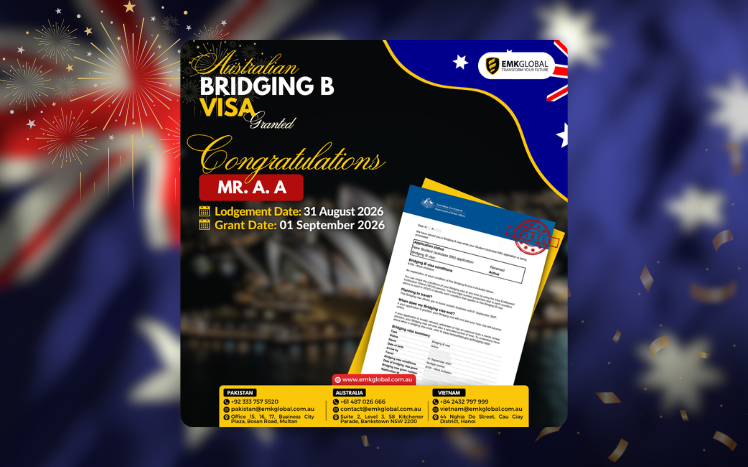
CONGRATULATIONS ON YOUR BRIDGING VISA B!

A very special congratulations to our client, Mr. A.A, on receiving his Bridging Visa B (BVB) in less than 24 hours!

With his visa granted, he can now travel overseas to be with his loved one and get married before returning to Australia.

For many visa holders, travelling overseas while an Australian visa application is being processed can be stressful and complicated. Getting the right advice and lodging the application correctly can make a big difference.

At EMK Global, we’re always happy to help our clients navigate their visa journey with care, clarity, and attention to detail.

Need to travel overseas while waiting for your visa? Contact the EMK Global team to discuss your situation and find out how we can assist.

Send us a message today!

EMK Global – Your Australian education & migration journey, supported.

#EMKGlobal #BridgingVisaB #BVB #AustralianVisa #VisaSuccess #AustraliaMigration #MigrationAustralia #StudyInAustralia #AustraliaVisa #VisaAssistance

August 31, 2026

February 2026 has been a pivotal month for both the Australian education and migration sectors, with several significant policy updates, regulatory changes, and emerging trends shaping student mobility, visa processes, and quality standards. These changes affect prospective and current students, education providers, and international recruitment stakeholders. 


Proposed Work-Rights Limit for Student Visa Holders 

A major policy proposal has gained significant attention in February: a call to limit student visa holders’ work rights to 60 hours per fortnight during term time. This proposal — floated publicly this month — would significantly tighten the already restricted work rights that international students currently enjoy while studying in Australia.  

Government and education sector stakeholders continue discussions about the potential impact on student finances, employment attraction, and Australia’s competitiveness as a global study destination. 


Tightened Student Visa Pathways & Genuine Student Test Changes 

In early February, Australian immigration authorities unveiled a suite of new student visa requirements aimed at strengthening the integrity of the system. These reforms include: 

  • Increased scrutiny of student visa applications 
  • Higher application fees 
  • More comprehensive genuine student tests to reduce visa misuse.  

While the full legislative details are underway, this shift signals a trend toward quality-over-quantity in international education entries, aligning Australia with global high-scrutiny systems. 


National Code Reform — Onshore Recruitment & Agent Commissions 

One of the most impactful changes this month has been an official amendment to the National Code of Practice for Providers of Education and Training to Overseas Students. 

The update prohibits providers from paying agent commissions for recruiting students already enrolled with another institution, with limited transitional exceptions.  

This reform aims to curb onshore poaching, improve compliance, and enhance transparency in agent-driven recruitment, affecting international student mobility and provider behaviour across the sector. 


Heightened Risk Classification for Indian Applicants 

In related international education news, Australia has re-classified India to the highest-risk migration assessment tier. This reclassification increases documentation scrutiny, requiring more robust proof of funds, clearer academic intent, and stronger genuine student evidence for applicants from India and the broader South Asian region.  

As the largest international student source market for Australia, this shift has implications for recruitment, application behaviours, and visa success projections. 


Quality Assurance Engagement & Sector Compliance Initiatives 

The Australian Skills Quality Authority (ASQA) has launched its 2026 sector engagement program, inviting education providers to face-to-face sessions focused on embedding the 2025 quality standards.  

This signals ongoing regulatory accountability and quality improvement throughout the vocational education and training (VET) sector, reinforcing Australia’s commitment to international education excellence. 


School Regulation Updates in NSW 

In education governance, the New South Wales Education Standards Authority (NESA) released its February 2026 School Registration Insights update. This includes revisions requiring explicit hate speech prohibitions in school staff conduct codes and updated manual resources for compliance.  

These changes emphasize professional standards and student welfare at the primary and secondary levels. 


Systemic Challenges: TAFE Workforce Concerns 

A newly published report has revealed concerning trends within the TAFE (Technical and Further Education) sector, where two-thirds of teachers are considering leaving the profession due to workload pressures, inadequate resources, and facility constraints.  

These systemic issues, reported amidst rising enrolments under Free TAFE incentives, highlight broader workforce sustainability pressures across Australia’s vocational education sector. 


What This Means for Education and Migration in 2026 

Together, these developments illustrate 2026 as a year of tightening standards, quality emphasis, and migration-policy recalibration: 

  • Stricter visa and recruitment compliance measures are being enforced.
  • Stakeholder debates around migration policy are intensifying with political positioning ahead of elections.
  • Education quality, integrity, and credential legitimacy remain priorities in regulatory agendas.
  • International student markets are facing greater scrutiny, particularly in major source regions.

Key Takeaways for Students & Providers

  • Expect stronger documentation requirements for student visas in 2026.
  • Agent and provider recruitment practices must align with the National Code reforms.
  • High-risk market applicants should prepare more rigorous evidence.
  • Quality compliance events (like ASQA engagement sessions) present opportunities for provider improvement.
  • Broader political migration policy discussions may influence future international student flows. 

Conclusion 

February 2026 has seen regulatory shifts that reflect Australia’s evolving approach to international education and migration — balancing integrity, quality, and sector sustainability. Whether you are a prospective student, agent, or education provider, understanding these changes is critical to planning a successful academic and migration pathway in Australia. 

August 27, 2026

VETASSESS has announced an upcoming increase to its Professional Skills Assessment fees, effective 9 September 2026.

According to VETASSESS, the fee adjustment is being made in line with movements in the Consumer Price Index (CPI) and has been reviewed in accordance with Australian Government guidance.

For applicants currently preparing a skills assessment, the upcoming change is an important deadline to be aware of.

Key Information at a Glance

Key Information Details
Fee increase effective from 9 September 2026
Applications received before 9 September 2026 Current fees will apply
Applications received from 9 September 2026 Updated fees will apply
Trade Occupation Assessments Not affected


Which Services Will Be Affected?

The fee increase will apply to Professional Skills Assessments and a number of related services.

These include Priority Processing (PP), Skills Assessment Support (SAS), Chinese Qualification Verification (CQV), Non-Migration Skills Assessments and Administration fees.

Importantly, VETASSESS has confirmed that the fee update does not apply to assessments for trade occupations.

Important Deadline: 9 September 2026

One of the most important points for applicants is that applications received by VETASSESS before 9 September 2026 will be charged at the current rates.

Applications received from 9 September 2026 onwards will be subject to the updated fees.

Therefore, applicants who are already ready to proceed with their assessment should carefully consider their application timeline and ensure their application is properly prepared before lodging.


Current Published VETASSESS Fees

VETASSESS currently lists the following fees for selected professional assessment services:

Service Applying from within Australia Applicant outside Australia
Full Skills Assessment AUD $1,205.60 AUD $1,096
Priority Processing* AUD $907.50 AUD $825
Points Test Advice AUD $342.10 AUD $311
485 Skills Assessment AUD $457.60 AUD $416

*Priority Processing is an additional fee on top of the Full Skills Assessment fee. Fees shown by VETASSESS may include or exclude GST depending on the applicant’s Australian tax residency status.

Applicants should check the official VETASSESS fee schedule before lodging, particularly around the 9 September 2026 fee change.


What Is a VETASSESS Skills Assessment?

A Skills Assessment is an important part of the professional occupation recognition process for people seeking to migrate to Australia.

VETASSESS assesses qualifications and employment experience to determine whether an applicant has the skills and knowledge required for their nominated occupation.

VETASSESS assesses a wide range of professional occupations across areas including:

  • Business and Finance
  • Arts and Education
  • Construction and Manufacturing
  • Hospitality and Retail
  • Science, Health and Agriculture


Why Is a Skills Assessment Important for Skilled Migration?

For several skilled migration pathways, applicants need to provide information about their skills assessment as part of the SkillSelect Expression of Interest (EOI) process.

The Department of Home Affairs states that applicants for skilled visas such as subclass 189, 190 and 491 need to submit an EOI before they can be invited to apply. Applicants also need a skills assessment in their nominated occupation before submitting their EOI.

However, having a positive skills assessment does not guarantee an invitation or visa grant. The Department of Home Affairs also makes clear that meeting the minimum points threshold does not guarantee an invitation, as invitation outcomes depend on the relevant program and selection process.


What Should Applicants Do Now?

If you are considering a skilled migration pathway and your occupation is assessed by VETASSESS, it is worth reviewing your situation before the fee change takes effect.

You should consider:

  • Checking whether VETASSESS is the relevant assessing authority for your nominated occupation.
  • Reviewing the qualification and employment requirements for your occupation.
  • Preparing your supporting documents carefully.
  • Checking that your employment history and qualifications can be properly evidenced.
  • If you are ready to lodge, being aware of the 9 September 2026 fee-change deadline.


Keep Your Migration Strategy Up to Date

A skills assessment is only one part of the overall skilled migration process. Your occupation, qualifications, work experience, English proficiency, points score and other circumstances can all affect your potential pathway.

The Department of Home Affairs also recommends keeping your EOI information up to date if your circumstances change, such as gaining additional work experience, obtaining a new qualification, improving your English proficiency or receiving a new skills assessment.


Need Help With Your Skills Assessment?

Planning your skills assessment carefully can help you avoid unnecessary delays and ensure that your qualifications and employment experience are presented appropriately.

📩 Contact EMK Global Education & Migration for assistance with reviewing your profile, understanding your potential skills assessment pathway and planning your next steps towards skilled migration in Australia.

Important: This article is provided for general information only and does not constitute migration or legal advice. VETASSESS assessment requirements, fees and Australian migration policies may change. Applicants should always check the latest information directly with VETASSESS and the Australian Department of Home Affairs.

Source: VETASSESS

August 27, 2026

Australia has introduced new processing priorities for certain skilled visa applications under Ministerial Direction 119 (MD119), which came into effect on 25 July 2026.

The new Direction replaces Ministerial Direction 105 (MD105) and introduces an important change to how skilled visa applications are prioritised: the Department of Home Affairs now considers both the applicant’s occupation and their location at the time of application.

For skilled migrants and employers, particularly those considering employer-sponsored or skilled migration pathways, understanding the new priority system can be important when planning their next steps.


What Is Ministerial Direction 119?

Ministerial Direction 119 determines the order in which the Department of Home Affairs processes nomination and visa applications for a range of skilled visa subclasses.

According to Home Affairs, MD119 applies to all applications currently on hand, including applications lodged before 25 July 2026 that have not yet been finalised.

The new Direction also covers the Skills in Demand visa (subclass 482), which was not previously included under MD105.


What Are the New Processing Priorities?

Under MD119, skilled nomination and visa applications are processed according to five priority groups:

Priority Applications
Priority 1 – Highest Law enforcement or defence-related occupations where the applicant was in Australia at the time of application
Priority 2 Law enforcement or defence-related occupations where the applicant was outside Australia at the time of application
Priority 3 Construction, healthcare and teaching occupations where the applicant was in Australia at the time of application
Priority 4 Other skilled applications where the applicant was in Australia at the time of application
Priority 5 Other skilled applications where the applicant was outside Australia at the time of application

This means that an applicant’s location at the time of application now plays an important role in determining processing priority.


What Does This Mean for Healthcare, Teaching and Construction Workers?

Construction, healthcare and teaching remain identified as priority occupation groups under MD119.

However, there is an important distinction.

Applicants in these occupations receive Priority 3 only where they were in Australia at the time of application.

For example, a nurse, teacher or construction professional who was in Australia when their application was lodged may fall within Priority 3.

By comparison, an applicant in the same occupation who was outside Australia when the application was lodged does not receive the same Priority 3 treatment. Unless they fall within the law enforcement or defence categories, offshore applications are processed under Priority 5.

Importantly, this does not mean offshore healthcare, teaching or construction professionals are no longer eligible for skilled migration.

MD119 determines processing priority. It does not, by itself, change the eligibility criteria for the relevant visa.


Which Skilled Visas Are Affected?

MD119 applies to a broad range of skilled migration visas, including:

  • Employer Nomination Scheme (subclass 186)
  • Skilled Independent (subclass 189)
  • Skilled Nominated (subclass 190)
  • Permanent Residence (Skilled Regional) (subclass 191)
  • Skills in Demand / Temporary Skill Shortage (subclass 482)
  • Skilled Work Regional (subclass 491)
  • Skilled Employer Sponsored Regional (subclass 494)

It also covers several other skilled and legacy visa subclasses specified by Home Affairs.

The inclusion of the Skills in Demand subclass 482 visa is particularly notable, as Home Affairs confirms that it was not previously included under MD105.

Does Higher Priority Guarantee Faster Processing?

Not necessarily.

A higher priority means the Department gives the application a higher position in its processing order. It does not guarantee a particular processing timeframe or a successful visa outcome.

Actual processing times can still depend on factors such as whether the application is complete, requests for additional information, health and character checks, application complexity, application volumes and Migration Program planning levels.

Home Affairs also notes that skilled visa applications are not necessarily processed in the order in which they are received.

In simple terms:

Processing priority ≠ visa eligibility ≠ guaranteed visa grant.


What About Applications Already Lodged?

MD119 applies to all applications currently on hand.

This means that applications lodged before 25 July 2026 but still awaiting processing may now be prioritised according to the new Direction.

Applicants with pending skilled visa applications should therefore be aware of where their application may sit within the new processing priority framework.


What Should Skilled Visa Applicants Do?

The introduction of MD119 highlights the importance of considering more than just visa eligibility when planning a skilled migration pathway.

Applicants should understand:

  • whether their visa subclass is covered by MD119;
  • which processing priority may apply to their circumstances;
  • whether their occupation falls within a priority occupation group; and
  • how their location at the time of application affects processing priority.

It is also important to ensure that applications are properly prepared and supported by the required evidence, as processing priority does not replace the requirement to satisfy all relevant visa criteria.


Need Help Understanding Your Skilled Migration Options?

Australia’s skilled migration framework continues to evolve, and changes to processing priorities may affect how applicants plan their next steps.

Contact EMK Global Education & Migration for assistance with reviewing your circumstances, understanding your potential skilled or employer-sponsored migration pathways, and planning your next steps.

Important: This article is provided for general information only and does not constitute migration or legal advice. Visa requirements, processing priorities and migration policies may change. Applicants should always check the latest information from the Australian Department of Home Affairs or seek professional advice relevant to their circumstances.

Source: Department of Home Affairs

August 21, 2026

Australia has introduced a major reform to its migration review system, removing the right to in-person hearings for international student visa appeals. The change comes as the government attempts to manage an unprecedented backlog of student visa refusal cases and curb the misuse of appeal pathways to extend lawful stay in Australia. 

The new laws significantly reshape how student visa appeals are handled by the Administrative Review Tribunal (ART) and signal a stricter, faster, and more document-focused approach to migration decision-making. 

How the Student Visa Appeal Process Worked Before the Change 

Prior to this reform, international students whose visas were refused had the right to: 

  • Request a merits review at the ART 
  • Attend an oral (in-person or virtual) hearing 
  • Explain personal circumstances verbally 
  • Clarify concerns about Genuine Student (GS) criteria 
  • Respond to tribunal member questions in real time 

This process was designed to ensure procedural fairness, especially for applicants with: 

  • Language barriers 
  • Complex personal or academic histories 
  • Medical, financial, or compassionate grounds 

However, while fair in theory, the system became increasingly inefficient and vulnerable to exploitation. 

Growing System Pressure 

  • Appeal processing times stretched to years 
  • Students could remain in Australia lawfully while waiting 
  • Many appeals were lodged with minimal merit 
  • Tribunal resources were overwhelmed 

By late 2024, the backlog crossed 20,000 student cases for the first time — a number that would more than double within a year. 


What Has Changed Under the New Law 

Under legislation passed in February 2026, the Australian government can now require that: 

  • Student visa appeals be decided solely on written submissions 
  • No oral or in-person hearings are required 
  • Tribunal members rely only on documents provided 
  • Decisions are made faster, with less procedural interaction 

The government estimates that removing oral hearings will save approximately one hour per case, enabling the ART to process thousands of additional cases annually. 

 Scale of the Backlog (as of November 2025) 

  • 48,826 active student visa appeals 
  • More than double the caseload from late 2024 
  • Median processing time: 1 year and 4 months 
  • Appeals lodged faster than they are resolved 

Between July and November 2025: 

  • 15,582 new cases lodged 
  • Only 4,823 cases finalised 

Why the Government Introduced This Reform 

The government has been clear that the appeal system was being used as a de facto visa extension mechanism, particularly by: 

  • Onshore student visa applicants 
  • Applicants refused under the Genuine Student requirement 
  • Temporary visa holders applying to “stay longer” 

Attorney-General Michelle Rowland stated that student visa refusals would be the first category targeted, describing the changes as necessary to restore integrity and efficiency. 

Former immigration officials have also highlighted that: 

  • Many student appeals raise similar GS issues 
  • Outcomes are unlikely to change significantly 
  • Faster decisions are needed to protect system credibility 


Key Differences: Before vs After the Change 

Aspect  Before  After 
Hearing type  Oral + written  Written only 
Student participation  Direct verbal explanation  Document-based only 
Processing time  Long delays  Faster decisions 
Tribunal workload  Heavy  Reduced 
Procedural fairness  Higher  More limited 
Appeal strategy  Narrative-based  Evidence-focused 


Concerns Raised by Stakeholders 

While asylum and refugee appeals are excluded from the reform due to their complexity, advocacy groups have raised concerns for international students. 

Key Issues Raised 

  • Written-only processes disadvantage students with poor English 
  • Mental health or compassionate circumstances harder to explain 
  • Increased risk of administrative errors 
  • Reduced opportunity to clarify misunderstandings 

Migration experts also warn that students may increasingly seek Federal Court review, arguing denial of natural justice — potentially shifting pressure from tribunals to courts. 


Future Predictions: What Happens Next? 

  1. FasterAppeal Outcomes 

The ART is expected to significantly increase monthly finalisations, reducing wait times over the next 12–24 months. 

  1. HigherRefusal Finalisation Rates 

Without oral advocacy, weak or poorly documented cases are more likely to be upheld as refusals. 

  1. FewerStrategic Appeals 

Students may become more cautious about lodging appeals purely to extend stay, reducing overall case volumes. 

  1. StrongerFocus on Initial Visa Quality 

Education agents and students will need to ensure: 

  • Strong Genuine Student statements 
  • Clear academic progression 
  • Proper financial and academic documentation 
  1. IncreasedRole of Professional Representation 

Written submissions must now be: 

  • Structured 
  • Evidence-based 
  • Legally coherent 

This increases reliance on qualified migration professionals rather than informal advice. 


What This Means for International Students 

The reform marks a clear shift in Australia’s migration stance: 

  • Less tolerance for weak or speculative applications 
  • Stronger enforcement of genuine student intent 
  • Greater emphasis on compliance at the first application stage 

International students planning to study in Australia must now approach visa applications with greater preparation and transparency, as appeal pathways have become narrower and more technical. 

Conclusion 

The removal of in-person hearings for student visa appeals represents one of the most significant changes to Australia’s migration review system in recent years. While the reform aims to restore efficiency and integrity, it also places greater responsibility on students to present strong, well-documented cases from the outset. 

As Australia balances migration control with international education interests, this policy shift is likely to reshape how student visas are applied for, assessed, and challenged in the years ahead. 

August 12, 2026

Whether you’re an international student, employee, freelancer, or business owner in Australia, you’ve probably heard of TFN and ABN. While both are issued by the Australian Government, they serve completely different purposes. 

Understanding the difference between a Tax File Number (TFN) and an Australian Business Number (ABN) is essential to ensure you meet your tax obligations and avoid unnecessary issues. 

What is a TFN (Tax File Number)? 

A Tax File Number (TFN) is a unique identification number issued by the Australian Taxation Office (ATO) for tax purposes. 

A TFN allows individuals to: 

  • Work legally in Australia 
  • Lodge annual tax returns 
  • Pay the correct amount of tax 
  • Access government services linked to taxation 
  • Open bank accounts and avoid higher withholding tax on interest 
  • Apply for Higher Education Loan Program (HELP) loans if eligible 

If you are employed by a company or organisation, your employer will ask for your TFN before processing your salary. 

Who Needs a TFN? 

You should apply for a TFN if you are: 

  • An international student studying in Australia 
  • A temporary visa holder with work rights 
  • A permanent resident 
  • An Australian citizen 
  • An employee working for an Australian employer 

Having a TFN helps ensure you pay the correct tax rate and receive any eligible tax refunds. 

What is an ABN (Australian Business Number)? 

An Australian Business Number (ABN) is an 11-digit identifier issued to businesses operating in Australia. 

An ABN is generally required if you: 

  • Run your own business 
  • Work as a sole trader 
  • Operate as an independent contractor 
  • Invoice clients for your services 
  • Register for Goods and Services Tax (GST) if required 

Unlike a TFN, an ABN identifies your business rather than your personal employment. 

Who Needs an ABN? 

You may need an ABN if you: 

  • Own a small business 
  • Work as a freelancer 
  • Drive for rideshare or delivery platforms 
  • Operate an online business 
  • Provide professional consulting services 
  • Work as an independent contractor 

Simply having an ABN does not automatically mean you are considered an employee. 

Can You Have Both a TFN and an ABN? 

Yes. 

Many Australians and international students have both. 

For example: 

  • You work part-time for a company using your TFN. 
  • You also run a photography business on weekends using your ABN. 

In this situation, your employment income is reported under your TFN, while your business income is linked to your ABN. 

TFN vs ABN: Key Differences 

TFN  ABN 
Used for personal taxation  Used for business identification 
Required for employees  Required for businesses and sole traders 
Issued by the Australian Taxation Office  Registered through the Australian Business Register 
Used to lodge individual tax returns  Used when invoicing clients and operating a business 
Linked to your personal income  Linked to business activities 

Can International Students Apply? 

Yes. 

International students with work rights can apply for a TFN after arriving in Australia. 

Students who genuinely operate a business or work as independent contractors may also be eligible to apply for an ABN, provided they meet the relevant business requirements. 

Common Mistakes to Avoid 

Many people mistakenly believe: 

  • An ABN replaces a TFN. 
  • Everyone should apply for an ABN. 
  • Employers can simply ask employees to get an ABN instead of employing them. 

These assumptions are incorrect. Whether you need a TFN, an ABN, or both depends on your work arrangement and business activities. 

Need Help Understanding TFN or ABN? 

Choosing the correct tax registration is important for complying with Australian tax laws. 

At EMK Global Education & Migration, we assist international students and migrants by providing guidance on studying, working, and settling in Australia. If you’re unsure whether you need a TFN, an ABN, or both, our team is here to help. 

Contact EMK Global today for professional advice and support on your journey in Australia. 

August 7, 2026

Lodging your tax return in Australia is an important annual responsibility for employees, international students, sole traders, and business owners. Whether you’re working full-time, part-time, casually, or running your own business, submitting an accurate tax return can help you receive your eligible tax refund while ensuring you comply with Australian tax laws. 

In this guide, we’ll explain what a tax return is, who needs to lodge one, important deadlines, and how you can maximise your refund. 

What Is a Tax Return? 

A tax return is a document submitted to the Australian Taxation Office (ATO) that reports your income, tax withheld, deductions, and other financial information for a financial year. 

After reviewing your return, the ATO will determine whether: 

  • You are entitled to a tax refund. 
  • You need to pay additional tax. 
  • Your tax obligations have been met. 

Who Needs to Lodge a Tax Return in Australia? 

You may need to lodge a tax return if you: 

  • Worked full-time, part-time, or casually. 
  • Are an international student with Australian income. 
  • Operated a business or worked as a sole trader. 
  • Earned investment or rental income. 
  • Received government payments that require reporting. 
  • Had tax withheld from your wages. 

Even if you earned a relatively low income, lodging a tax return may allow you to receive a tax refund if too much tax was withheld during the year. 

When Can You Lodge Your Tax Return? 

The Australian financial year runs from 1 July to 30 June. 

Most individuals can begin lodging their tax return from 1 July after the financial year ends. The standard deadline for self-lodged tax returns is generally 31 October, although different due dates may apply if you use a registered tax agent. 

Documents You’ll Need 

Before lodging your tax return, gather the following documents: 

  • Tax File Number (TFN) 
  • Income Statement or PAYG Summary 
  • Bank account details 
  • Employer information 
  • Receipts for eligible work-related expenses 
  • Investment or rental income records (if applicable) 
  • Business income and expense records (if self-employed) 
  • Private health insurance details (if applicable) 

Having accurate records helps ensure your tax return is completed correctly. 

Common Tax Deductions 

Depending on your occupation and circumstances, you may be able to claim eligible deductions for: 

  • Work-related travel 
  • Uniforms and protective clothing 
  • Self-education expenses 
  • Professional memberships 
  • Tools and equipment 
  • Home office expenses 
  • Internet and phone costs used for work 

Only claim deductions that you are legally entitled to and keep supporting evidence for your claims. 

Tax Returns for International Students 

International students who work in Australia may also need to lodge a tax return. 

If tax has been withheld from your wages, you may be eligible for a refund depending on your total income and individual circumstances. 

Understanding your residency status for tax purposes is important, as it can affect how your tax is calculated. 

Tax Returns for Sole Traders and Businesses 

If you operate a business or work under an Australian Business Number (ABN), your tax return may include: 

  • Business income 
  • Business expenses 
  • Asset purchases 
  • Vehicle expenses 
  • Home office expenses 
  • GST obligations (where applicable) 

Maintaining accurate financial records throughout the year can make tax time much easier. 

Common Mistakes to Avoid 

Many taxpayers delay or reduce their refund by making avoidable mistakes, such as: 

  • Forgetting to declare all income. 
  • Claiming deductions without supporting evidence. 
  • Providing incorrect bank account details. 
  • Waiting until the last minute to lodge. 
  • Not keeping receipts for deductible expenses. 

Reviewing your information carefully before submission can help avoid delays. 

Why Lodge Your Tax Return Early? 

Lodging your tax return early can help you: 

  • Receive your refund sooner. 
  • Meet your tax obligations on time. 
  • Avoid unnecessary penalties. 
  • Better manage your finances. 

However, it’s important to ensure all income information has been finalised before lodging. 

Need Help with Your Australian Tax Return? 

Preparing a tax return can sometimes be confusing, especially if you’re an international student, temporary visa holder, freelancer, or business owner. 

At EMK Global Education & Migration, we assist individuals with understanding the Australian taxation process and connecting them with professional support for accurate tax return preparation. 

Contact EMK Global today for reliable guidance on lodging your Australian tax return and maximising your eligible tax refund.