Hi, How Can We Help You?
  • Level 3, 58 Kitchener Pde, Bankstown Sydney NSW
  • contact@emkglobal.com.au
  • (+61) 487 026 666

Tag Archives: EMK Global

August 21, 2026

Australia has introduced a major reform to its migration review system, removing the right to in-person hearings for international student visa appeals. The change comes as the government attempts to manage an unprecedented backlog of student visa refusal cases and curb the misuse of appeal pathways to extend lawful stay in Australia. 

The new laws significantly reshape how student visa appeals are handled by the Administrative Review Tribunal (ART) and signal a stricter, faster, and more document-focused approach to migration decision-making. 

How the Student Visa Appeal Process Worked Before the Change 

Prior to this reform, international students whose visas were refused had the right to: 

  • Request a merits review at the ART 
  • Attend an oral (in-person or virtual) hearing 
  • Explain personal circumstances verbally 
  • Clarify concerns about Genuine Student (GS) criteria 
  • Respond to tribunal member questions in real time 

This process was designed to ensure procedural fairness, especially for applicants with: 

  • Language barriers 
  • Complex personal or academic histories 
  • Medical, financial, or compassionate grounds 

However, while fair in theory, the system became increasingly inefficient and vulnerable to exploitation. 

Growing System Pressure 

  • Appeal processing times stretched to years 
  • Students could remain in Australia lawfully while waiting 
  • Many appeals were lodged with minimal merit 
  • Tribunal resources were overwhelmed 

By late 2024, the backlog crossed 20,000 student cases for the first time — a number that would more than double within a year. 


What Has Changed Under the New Law 

Under legislation passed in February 2026, the Australian government can now require that: 

  • Student visa appeals be decided solely on written submissions 
  • No oral or in-person hearings are required 
  • Tribunal members rely only on documents provided 
  • Decisions are made faster, with less procedural interaction 

The government estimates that removing oral hearings will save approximately one hour per case, enabling the ART to process thousands of additional cases annually. 

 Scale of the Backlog (as of November 2025) 

  • 48,826 active student visa appeals 
  • More than double the caseload from late 2024 
  • Median processing time: 1 year and 4 months 
  • Appeals lodged faster than they are resolved 

Between July and November 2025: 

  • 15,582 new cases lodged 
  • Only 4,823 cases finalised 

Why the Government Introduced This Reform 

The government has been clear that the appeal system was being used as a de facto visa extension mechanism, particularly by: 

  • Onshore student visa applicants 
  • Applicants refused under the Genuine Student requirement 
  • Temporary visa holders applying to “stay longer” 

Attorney-General Michelle Rowland stated that student visa refusals would be the first category targeted, describing the changes as necessary to restore integrity and efficiency. 

Former immigration officials have also highlighted that: 

  • Many student appeals raise similar GS issues 
  • Outcomes are unlikely to change significantly 
  • Faster decisions are needed to protect system credibility 


Key Differences: Before vs After the Change 

Aspect  Before  After 
Hearing type  Oral + written  Written only 
Student participation  Direct verbal explanation  Document-based only 
Processing time  Long delays  Faster decisions 
Tribunal workload  Heavy  Reduced 
Procedural fairness  Higher  More limited 
Appeal strategy  Narrative-based  Evidence-focused 


Concerns Raised by Stakeholders 

While asylum and refugee appeals are excluded from the reform due to their complexity, advocacy groups have raised concerns for international students. 

Key Issues Raised 

  • Written-only processes disadvantage students with poor English 
  • Mental health or compassionate circumstances harder to explain 
  • Increased risk of administrative errors 
  • Reduced opportunity to clarify misunderstandings 

Migration experts also warn that students may increasingly seek Federal Court review, arguing denial of natural justice — potentially shifting pressure from tribunals to courts. 


Future Predictions: What Happens Next? 

  1. FasterAppeal Outcomes 

The ART is expected to significantly increase monthly finalisations, reducing wait times over the next 12–24 months. 

  1. HigherRefusal Finalisation Rates 

Without oral advocacy, weak or poorly documented cases are more likely to be upheld as refusals. 

  1. FewerStrategic Appeals 

Students may become more cautious about lodging appeals purely to extend stay, reducing overall case volumes. 

  1. StrongerFocus on Initial Visa Quality 

Education agents and students will need to ensure: 

  • Strong Genuine Student statements 
  • Clear academic progression 
  • Proper financial and academic documentation 
  1. IncreasedRole of Professional Representation 

Written submissions must now be: 

  • Structured 
  • Evidence-based 
  • Legally coherent 

This increases reliance on qualified migration professionals rather than informal advice. 


What This Means for International Students 

The reform marks a clear shift in Australia’s migration stance: 

  • Less tolerance for weak or speculative applications 
  • Stronger enforcement of genuine student intent 
  • Greater emphasis on compliance at the first application stage 

International students planning to study in Australia must now approach visa applications with greater preparation and transparency, as appeal pathways have become narrower and more technical. 

Conclusion 

The removal of in-person hearings for student visa appeals represents one of the most significant changes to Australia’s migration review system in recent years. While the reform aims to restore efficiency and integrity, it also places greater responsibility on students to present strong, well-documented cases from the outset. 

As Australia balances migration control with international education interests, this policy shift is likely to reshape how student visas are applied for, assessed, and challenged in the years ahead. 

August 12, 2026

Whether you’re an international student, employee, freelancer, or business owner in Australia, you’ve probably heard of TFN and ABN. While both are issued by the Australian Government, they serve completely different purposes. 

Understanding the difference between a Tax File Number (TFN) and an Australian Business Number (ABN) is essential to ensure you meet your tax obligations and avoid unnecessary issues. 

What is a TFN (Tax File Number)? 

Tax File Number (TFN) is a unique identification number issued by the Australian Taxation Office (ATO) for tax purposes. 

A TFN allows individuals to: 

  • Work legally in Australia 
  • Lodge annual tax returns 
  • Pay the correct amount of tax 
  • Access government services linked to taxation 
  • Open bank accounts and avoid higher withholding tax on interest 
  • Apply for Higher Education Loan Program (HELP) loans if eligible 

If you are employed by a company or organisation, your employer will ask for your TFN before processing your salary. 

Who Needs a TFN? 

You should apply for a TFN if you are: 

  • An international student studying in Australia 
  • A temporary visa holder with work rights 
  • A permanent resident 
  • An Australian citizen 
  • An employee working for an Australian employer 

Having a TFN helps ensure you pay the correct tax rate and receive any eligible tax refunds. 

What is an ABN (Australian Business Number)? 

An Australian Business Number (ABN) is an 11-digit identifier issued to businesses operating in Australia. 

An ABN is generally required if you: 

  • Run your own business 
  • Work as a sole trader 
  • Operate as an independent contractor 
  • Invoice clients for your services 
  • Register for Goods and Services Tax (GST) if required 

Unlike a TFN, an ABN identifies your business rather than your personal employment. 

Who Needs an ABN? 

You may need an ABN if you: 

  • Own a small business 
  • Work as a freelancer 
  • Drive for rideshare or delivery platforms 
  • Operate an online business 
  • Provide professional consulting services 
  • Work as an independent contractor 

Simply having an ABN does not automatically mean you are considered an employee. 

Can You Have Both a TFN and an ABN? 

Yes. 

Many Australians and international students have both. 

For example: 

  • You work part-time for a company using your TFN. 
  • You also run a photography business on weekends using your ABN. 

In this situation, your employment income is reported under your TFN, while your business income is linked to your ABN. 

TFN vs ABN: Key Differences 

TFN  ABN 
Used for personal taxation  Used for business identification 
Required for employees  Required for businesses and sole traders 
Issued by the Australian Taxation Office  Registered through the Australian Business Register 
Used to lodge individual tax returns  Used when invoicing clients and operating a business 
Linked to your personal income  Linked to business activities 

Can International Students Apply? 

Yes. 

International students with work rights can apply for a TFN after arriving in Australia. 

Students who genuinely operate a business or work as independent contractors may also be eligible to apply for an ABN, provided they meet the relevant business requirements. 

Common Mistakes to Avoid 

Many people mistakenly believe: 

  • An ABN replaces a TFN. 
  • Everyone should apply for an ABN. 
  • Employers can simply ask employees to get an ABN instead of employing them. 

These assumptions are incorrect. Whether you need a TFN, an ABN, or both depends on your work arrangement and business activities. 

Need Help Understanding TFN or ABN? 

Choosing the correct tax registration is important for complying with Australian tax laws. 

At EMK Global Education & Migration, we assist international students and migrants by providing guidance on studying, working, and settling in Australia. If you’re unsure whether you need a TFN, an ABN, or both, our team is here to help. 

Contact EMK Global today for professional advice and support on your journey in Australia. 

August 7, 2026

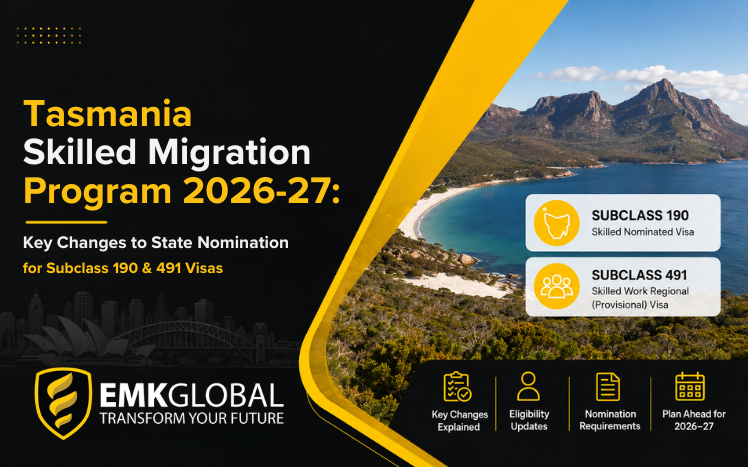
The Tasmanian Government has announced significant updates to the 2026–27 Tasmanian Skilled Migration State Nomination Program, with new eligibility requirements, revised priority attributes, updated income thresholds, and changes to supporting documentation. 

These changes affect applicants seeking nomination under the Skilled Nominated Visa (Subclass 190) and the Skilled Work Regional Visa (Subclass 491). 

If you are planning to apply for Tasmanian state nomination, understanding these updates is essential. 

Tasmania Receives 2,050 Nomination Places 

For the 2026–27 program year, Tasmania has received: 

  • 1,250 nomination places for the Subclass 190 Skilled Nominated Visa 
  • 800 nomination places for the Subclass 491 Skilled Work Regional Visa 

Major Changes to Eligibility Requirements 

Several important updates have been introduced across the Tasmanian Skilled Employment, Tasmanian Skilled Graduate, Tasmanian Established Resident and Business Operator pathways. 

Key changes include: 

  • Applicants who meet the Subclass 190 pathway requirements but are not eligible for a Subclass 190 visa due to skills assessment or SkillSelect point limitations may still submit a Registration of Interest (ROI). If approved, they may instead receive nomination for the Subclass 491 visa. 
  • References to the previous salary requirement have been replaced with a new “Priority Income Level.” 
  • Business income thresholds have been updated in line with the increased Temporary Skilled Migration Income Threshold (TSMIT). 

Updated Income Thresholds 

The revised income levels include: 

  • Priority Income Level: $57,000 per year or $28.85 per hour 
  • TSMIT: $79,423 per year 
  • 90% of TSMIT: $71,480 per year 
  • Average Annual Earnings: $106,600 per year 

These figures are now used across several nomination pathways and priority attributes. 

Changes to the Tasmanian Skilled Employment (TSE) Pathway 

Applicants under the Tasmanian Skilled Employment pathway will notice several important changes: 

  • Gold priority now requires applicants to have worked in Tasmania for the past six months, with at least one job providing a minimum of 30 hours per week. 
  • New point allocations have been introduced for different employment durations. 
  • Greater emphasis has been placed on Tasmanian employment as an indicator of long-term settlement. 
  • Some previous industry experience attributes have been reduced in priority. 

Updates for Tasmanian Skilled Graduates 

Graduates will benefit from several new priority attributes, including: 

  • Additional points for applicants who have lived, studied and worked only in Tasmania. 
  • New Orange-Plus priority attributes for employment directly related to Tasmanian study. 
  • Increased points for higher salary levels. 
  • Recognition of employment gained before graduation where it meets eligibility requirements. 

Changes for Established Residents 

The Tasmanian Established Resident pathway now includes: 

  • New priority attributes for applicants with two years’ industry experience while earning above the Priority Income Level. 
  • Additional points for applicants who have only lived in Tasmania during their Australian residence. 
  • New scoring options for applicants earning below the Priority Income Level. 

Important Employment Rule Changes 

Migration Tasmania has clarified several employment assessment rules, including: 

  • Employment must generally average at least 20 hours per week. 
  • Multiple jobs may be combined to meet minimum hours in some pathways; however, each job must independently satisfy income requirements where applicable. 
  • Annual leave, personal leave and maternity leave may count towards eligible employment if residency requirements are maintained. 
  • Significant employment gaps may reset qualifying employment periods. 

New Occupation-Specific Rules 

Additional guidance has been introduced for certain occupations. 

Massage Therapists 

From 1 December 2026, employment will only be recognised where work is performed in health, allied health, aged care or disability care settings. 

Motor Mechanics and Auto Service Technicians 

From 1 December 2026, stricter employer eligibility requirements will apply. 

Applicants may also be required to provide additional evidence, including manufacturer training certificates, diagnostic reports and customer service records. 

Stronger Employment Verification 

Migration Tasmania has introduced additional measures to verify genuine employment. 

Applications may receive additional scrutiny where: 

  • Employment appears inconsistent with the employer’s business. 
  • Unusual financial transactions exist between employer and employee. 
  • Salary arrangements do not align with market rates. 

Applicants must also demonstrate that wages comply with the relevant Australian award or enterprise agreement. 

Supporting Document Updates 

Several supporting document requirements have been strengthened. 

Applicants may now need to provide: 

  • Australian Taxation Office (ATO) superannuation payment statements. 
  • Casual employment summaries (where multiple casual jobs are claimed). 
  • Evidence confirming pay rates meet applicable award requirements. 
  • USI transcripts for eligible VET graduates. 
  • Additional evidence for PhD research claims. 

What These Changes Mean for Skilled Migrants 

The 2026–27 changes place a stronger emphasis on: 

  • Genuine long-term employment in Tasmania 
  • Employment related to skills assessments or Tasmanian study 
  • Higher income levels 
  • Strong evidence supporting employment claims 
  • Long-term commitment to living and working in Tasmania 

Applicants should carefully review the updated eligibility criteria before lodging a Registration of Interest or nomination application. 

Need Help with Your Tasmania Skilled Migration Application? 

At EMK Global Education & Migration, our registered migration professionals can assess your eligibility, explain the latest policy updates, and help you prepare a strong application for Tasmanian State Nomination under the Subclass 190 or Subclass 491 visa pathways. 

Contact EMK Global today for expert migration advice and personalised assistance.