

Hi, How Can We Help You?
  • Level 3, 58 Kitchener Pde, Bankstown Sydney NSW
  • contact@emkglobal.com.au
  • (+61) 487 026 666

Tag Archives: EMK Global Australia Guide

August 12, 2026

Whether you’re an international student, employee, freelancer, or business owner in Australia, you’ve probably heard of TFN and ABN. While both are issued by the Australian Government, they serve completely different purposes. 

Understanding the difference between a Tax File Number (TFN) and an Australian Business Number (ABN) is essential to ensure you meet your tax obligations and avoid unnecessary issues. 

What is a TFN (Tax File Number)? 

Tax File Number (TFN) is a unique identification number issued by the Australian Taxation Office (ATO) for tax purposes. 

A TFN allows individuals to: 

  • Work legally in Australia 
  • Lodge annual tax returns 
  • Pay the correct amount of tax 
  • Access government services linked to taxation 
  • Open bank accounts and avoid higher withholding tax on interest 
  • Apply for Higher Education Loan Program (HELP) loans if eligible 

If you are employed by a company or organisation, your employer will ask for your TFN before processing your salary. 

Who Needs a TFN? 

You should apply for a TFN if you are: 

  • An international student studying in Australia 
  • A temporary visa holder with work rights 
  • A permanent resident 
  • An Australian citizen 
  • An employee working for an Australian employer 

Having a TFN helps ensure you pay the correct tax rate and receive any eligible tax refunds. 

What is an ABN (Australian Business Number)? 

An Australian Business Number (ABN) is an 11-digit identifier issued to businesses operating in Australia. 

An ABN is generally required if you: 

  • Run your own business 
  • Work as a sole trader 
  • Operate as an independent contractor 
  • Invoice clients for your services 
  • Register for Goods and Services Tax (GST) if required 

Unlike a TFN, an ABN identifies your business rather than your personal employment. 

Who Needs an ABN? 

You may need an ABN if you: 

  • Own a small business 
  • Work as a freelancer 
  • Drive for rideshare or delivery platforms 
  • Operate an online business 
  • Provide professional consulting services 
  • Work as an independent contractor 

Simply having an ABN does not automatically mean you are considered an employee. 

Can You Have Both a TFN and an ABN? 

Yes. 

Many Australians and international students have both. 

For example: 

  • You work part-time for a company using your TFN. 
  • You also run a photography business on weekends using your ABN. 

In this situation, your employment income is reported under your TFN, while your business income is linked to your ABN. 

TFN vs ABN: Key Differences 

TFN ABN 
Used for personal taxation Used for business identification 
Required for employees Required for businesses and sole traders 
Issued by the Australian Taxation Office Registered through the Australian Business Register 
Used to lodge individual tax returns Used when invoicing clients and operating a business 
Linked to your personal income Linked to business activities 

Can International Students Apply? 

Yes. 

International students with work rights can apply for a TFN after arriving in Australia. 

Students who genuinely operate a business or work as independent contractors may also be eligible to apply for an ABN, provided they meet the relevant business requirements. 

Common Mistakes to Avoid 

Many people mistakenly believe: 

  • An ABN replaces a TFN. 
  • Everyone should apply for an ABN. 
  • Employers can simply ask employees to get an ABN instead of employing them. 

These assumptions are incorrect. Whether you need a TFN, an ABN, or both depends on your work arrangement and business activities. 

Need Help Understanding TFN or ABN? 

Choosing the correct tax registration is important for complying with Australian tax laws. 

At EMK Global Education & Migration, we assist international students and migrants by providing guidance on studying, working, and settling in Australia. If you’re unsure whether you need a TFN, an ABN, or both, our team is here to help. 

Contact EMK Global today for professional advice and support on your journey in Australia. 
August 3, 2026

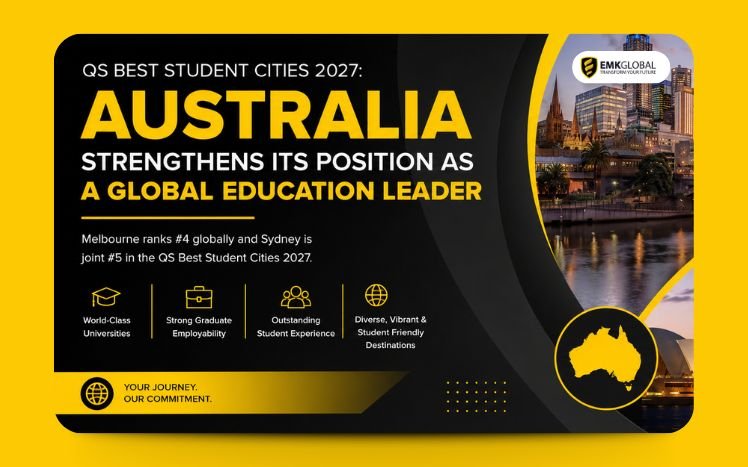
The latest QS Best Student Cities 2027 rankings have once again highlighted Australia as one of the world’s most attractive destinations for international students. With Melbourne ranked #4 globally and Sydney securing a joint #5 position, Australia continues to demonstrate why it remains a preferred study destination for students seeking high-quality education, excellent career prospects, and an exceptional lifestyle. 

Published annually by QS Quacquarelli Symonds, the Best Student Cities ranking evaluates 150 cities worldwide based on factors that matter most to students, including university rankings, graduate employability, affordability, student diversity, quality of life, and student satisfaction. 

As global competition for international education continues to grow, the 2027 rankings also reveal the increasing influence of Asia-Pacific cities, while Australia continues to maintain its reputation as one of the world’s leading education hubs.

QS Best Student Cities 2027 – Top 10 Rankings

According to the latest QS rankings, the world’s leading student cities are: 

  1. Seoul 
  1. Tokyo 
  1. London 
  1. Melbourne 
  1. Sydney (Joint with Munich) 
  1. Munich 
  1. Berlin 
  1. Paris 
  1. Zurich 
  1. Vienna 

Melbourne and Sydney’s positions within the global Top 5 reinforce Australia’s commitment to delivering world-class education combined with an outstanding student experience. 

Why Melbourne and Sydney Continue to Attract International Students 

Australia has consistently been one of the most popular destinations for students from around the world, offering internationally recognised qualifications, multicultural communities, and excellent post-study opportunities. 

World-Class Universities 

Melbourne and Sydney are home to some of Australia’s highest-ranked universities, renowned for academic excellence, innovative teaching, cutting-edge research, and strong industry connections. Graduates from Australian institutions are recognised globally, making Australian qualifications highly valued by employers worldwide. 

Strong Graduate Employability 

One of the key indicators in the QS rankings is Employer Activity, reflecting how well graduates are prepared for employment. 

Australia continues to perform strongly in this area, with universities maintaining close partnerships with industry and offering internships, practical learning experiences, networking opportunities, and career development services that prepare students for successful careers. 

Outstanding Student Experience 

Beyond academics, Melbourne and Sydney provide an exceptional quality of life. 

International students benefit from: 

  • Safe and welcoming communities 
  • Excellent public transport 
  • Modern healthcare services 
  • Diverse cultural experiences 
  • Vibrant food, arts, and entertainment scenes 
  • Access to beaches, parks, and outdoor activities 

These factors contribute to an enriching student experience both inside and outside the classroom. 

Asia-Pacific Continues to Rise in Global Education 

The 2027 rankings also highlight the growing strength of Asia-Pacific as a global education destination. 

Several cities recorded impressive improvements this year, including: 

  • Singapore (#11) 
  • Beijing (#12) 
  • Taipei (#14) 
  • Kuala Lumpur (#15) 
  • Kyoto (Improved ranking) 

The continued rise of these cities reflects increasing investment in higher education, innovation, graduate employability, and international student support. 

Meanwhile, several North American cities experienced declines due to rising living costs and affordability challenges, making Asia-Pacific destinations increasingly attractive for students seeking both quality education and better value. 

How QS Determines the Best Student Cities 

The QS Best Student Cities rankings evaluate destinations using a range of important indicators, including: 

  • University rankings and academic reputation 
  • Employer activity and graduate employability 
  • Affordability and cost of living 
  • Student diversity 
  • Student satisfaction and overall experience 
  • Desirability, safety, and quality of life 

Together, these indicators provide students with a comprehensive understanding of which cities offer the best overall study experience. 

Choosing the Right Study Destination 

While global rankings provide valuable guidance, choosing where to study should also align with individual goals, career aspirations, preferred lifestyle, and financial circumstances. 

Australia continues to offer excellent opportunities across a wide range of study areas, including: 

  • Business 
  • Information Technology 
  • Engineering 
  • Health Sciences 
  • Early Childhood Education 
  • Hospitality 
  • Construction 
  • Community Services 
  • Nursing 
  • Accounting 

Whether pursuing vocational education, undergraduate studies, or postgraduate qualifications, selecting the right city and institution can have a significant impact on both academic success and future career opportunities. 

Begin Your Study Abroad Journey with EMK Global

Choosing the right university and study destination is one of the most important decisions an international student will make. At EMK Global Education & Migration, our experienced education consultants provide personalised guidance throughout every stage of the application process. 

Our services include: 

  • University and course selection 
  • Admission application support 
  • Scholarship guidance 
  • Student visa assistance 
  • Genuine Student (GS) statement preparation 
  • Ongoing support before and after enrolment 

Whether your goal is to study in MelbourneSydney, or another leading education destination, our team is here to help turn your ambitions into reality. 

Contact EMK Global Today 

Ready to begin your international education journey? 

Contact EMK Global Education & Migration today to explore study opportunities in Australia’s top-ranked student cities and receive expert guidance tailored to your academic and career goals. 

SEO Keywords: QS Best Student Cities 2027, Study in Australia, Melbourne universities, Sydney universities, International Students Australia, Best Student Cities, Australian Universities, Study Abroad Australia, Higher Education Australia, Student Visa Australia, EMK Global Education & Migration. 


November 18, 2025

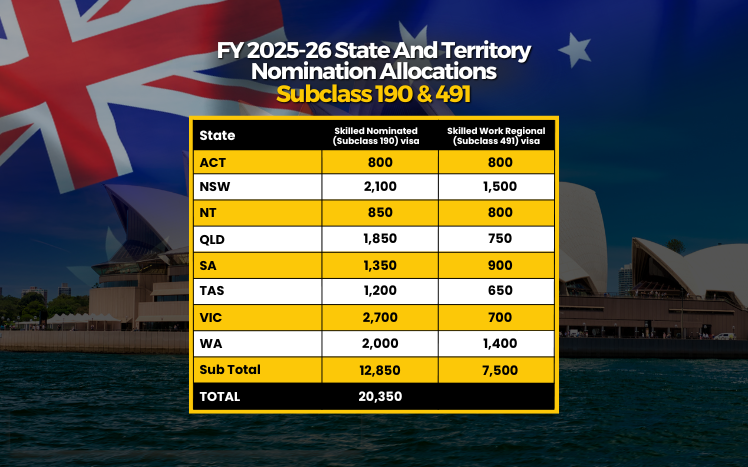
The Australian Department of Home Affairs has released the 2025–26 state and territory nomination allocations for the Skilled Nominated (Subclass 190) visa and the Skilled Work Regional (Subclass 491) visa. These allocations determine how many skilled migrants each state and territory can nominate for permanent and provisional residency pathways over the financial year.This year’s figures reveal a significant tightening across both visa subclasses, signaling increased competitiveness and more targeted migration strategies by state governments.

1. National Overview

For the 2025–26 program year, the total number of places allocated is:
Subclass 190: 12,850 places
Subclass 491: 7,500 places
Total: 20,350 places

This marks a notable reduction from the 2024–25 allocation, reflecting the government’s continued shift toward a smaller, more skilled, and more targeted migration program.

2. Subclass 190 – Skilled Nominated Visa

National Trend: Reduced Capacity
The 190 program has dropped from 16,500 places last year to 12,850 places in 2025–26, a reduction of 3,650 positions nationwide.
State-by-State Breakdown:
– ACT – 800
– NSW – 2,100
– NT – 850
– QLD – 1,850
– SA – 1,350
– TAS – 200
– VIC – 2,700
– WA – 2,000

Key Observations

  • Victoria (2,700 places) now holds the largest 190 allocation, overtaking NSW.
  • Western Australia continues an upward trend, reflecting demand in construction, engineering, and health.
  • NSW has experienced a significant reduction, likely leading to tougher selection criteria and higher competitiveness.
  • South Australia and Tasmania have seen sharp decreases, suggesting more targeted occupation lists and possibly prioritisation for onshore applicants

3. Subclass 491 – Skilled Work Regional Visa

National Trend: Moderate Decrease
The 491 program decreased from 9,760 places last year to 7,500 places for 2025–26.State-by-State Breakdown:
– ACT – 800
– NSW – 1,500
– NT – 800
– QLD – 750
– SA – 900
– TAS – 650
– VIC – 700
– WA – 1,400

Key Observations

– NSW remains the largest regional program, despite its reduction.
– Western Australia retains a strong focus on regional development, with 1,400 places.
– South Australia continues to prioritise regional migration with 900 allocations.
– States such as Queensland, Tasmania, and Victoria operate moderate-sized programs with selective criteria.

4. What These Changes Mean for Applicants

Higher Competition Across All States!

With reduced nomination numbers, states will become increasingly selective. Applicants with strong points, relevant work experience, and high English proficiency will be favoured.

Emphasis on Targeted Skills

States are expected to prioritise:
– Critical skill shortages
– Health, engineering, construction, and education sectors
– Applicants with strong employment evidence
– Onshore applicants with established ties

491 Remains an Important Pathway

While the 190 program has become more competitive, the 491 visa remains a valuable pathway for applicants willing to live and work in regional Australia.

5. Strategic Advice for 2025–26 Applicants

To remain competitive in the new migration landscape, applicants should consider:

5.1. Maximising Points
– Improve English scores
– Gain additional work experience
– Obtain partner skills points (if applicable)

5.2.⁠⁠ Building State/Territory Alignment
– Review each state’s occupation list and nomination criteria
– Strengthen ties such as employment, study, or community engagement
– Prepare compliant documentation early

5.3. ⁠⁠Considering Regional Pathways
With limited 190 places, regional options under the 491 visa may provide faster nomination opportunities, particularly in states like NSW, WA, and SA.

5.4. ⁠⁠Staying Updated
State nomination programs can change rapidly. Regular monitoring of updates ensures you do not miss closing windows or newly introduced priority occupations.

6.⁠⁠ Final Thoughts

The 2025–26 allocation signals a more targeted and strategic skilled migration program, with states focusing on applicants who can meet immediate labourmarket needs. While competition has increased, opportunities remain strong for applicants who prepare early, understand state priorities, and position themselves effectively.

For personalised advice on your best visa pathway under the 2025–26 program, contact our migration team —we’re here to help you navigate every step of the process.

Source: Allocations published on the Department of Home Affairs’websiteon 18 November 2025