
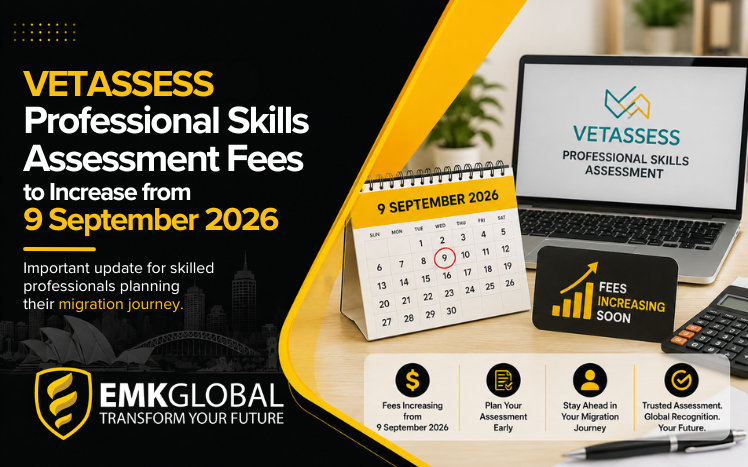
VETASSESS has announced an upcoming increase to its Professional Skills Assessment fees, effective 9 September 2026.
According to VETASSESS, the fee adjustment is being made in line with movements in the Consumer Price Index (CPI) and has been reviewed in accordance with Australian Government guidance.
For applicants currently preparing a skills assessment, the upcoming change is an important deadline to be aware of.
Key Information at a Glance
| Key Information | Details |
| Fee increase effective from | 9 September 2026 |
| Applications received before 9 September 2026 | Current fees will apply |
| Applications received from 9 September 2026 | Updated fees will apply |
| Trade Occupation Assessments | Not affected |
Which Services Will Be Affected?
The fee increase will apply to Professional Skills Assessments and a number of related services.
These include Priority Processing (PP), Skills Assessment Support (SAS), Chinese Qualification Verification (CQV), Non-Migration Skills Assessments and Administration fees.
Importantly, VETASSESS has confirmed that the fee update does not apply to assessments for trade occupations.
Important Deadline: 9 September 2026
One of the most important points for applicants is that applications received by VETASSESS before 9 September 2026 will be charged at the current rates.
Applications received from 9 September 2026 onwards will be subject to the updated fees.
Therefore, applicants who are already ready to proceed with their assessment should carefully consider their application timeline and ensure their application is properly prepared before lodging.
Current Published VETASSESS Fees
VETASSESS currently lists the following fees for selected professional assessment services:
| Service | Applying from within Australia | Applicant outside Australia |
| Full Skills Assessment | AUD $1,205.60 | AUD $1,096 |
| Priority Processing* | AUD $907.50 | AUD $825 |
| Points Test Advice | AUD $342.10 | AUD $311 |
| 485 Skills Assessment | AUD $457.60 | AUD $416 |
*Priority Processing is an additional fee on top of the Full Skills Assessment fee. Fees shown by VETASSESS may include or exclude GST depending on the applicant’s Australian tax residency status.
Applicants should check the official VETASSESS fee schedule before lodging, particularly around the 9 September 2026 fee change.
What Is a VETASSESS Skills Assessment?
A Skills Assessment is an important part of the professional occupation recognition process for people seeking to migrate to Australia.
VETASSESS assesses qualifications and employment experience to determine whether an applicant has the skills and knowledge required for their nominated occupation.
VETASSESS assesses a wide range of professional occupations across areas including:
- Business and Finance
- Arts and Education
- Construction and Manufacturing
- Hospitality and Retail
- Science, Health and Agriculture
Why Is a Skills Assessment Important for Skilled Migration?
For several skilled migration pathways, applicants need to provide information about their skills assessment as part of the SkillSelect Expression of Interest (EOI) process.
The Department of Home Affairs states that applicants for skilled visas such as subclass 189, 190 and 491 need to submit an EOI before they can be invited to apply. Applicants also need a skills assessment in their nominated occupation before submitting their EOI.
However, having a positive skills assessment does not guarantee an invitation or visa grant. The Department of Home Affairs also makes clear that meeting the minimum points threshold does not guarantee an invitation, as invitation outcomes depend on the relevant program and selection process.
What Should Applicants Do Now?
If you are considering a skilled migration pathway and your occupation is assessed by VETASSESS, it is worth reviewing your situation before the fee change takes effect.
You should consider:
- Checking whether VETASSESS is the relevant assessing authority for your nominated occupation.
- Reviewing the qualification and employment requirements for your occupation.
- Preparing your supporting documents carefully.
- Checking that your employment history and qualifications can be properly evidenced.
- If you are ready to lodge, being aware of the 9 September 2026 fee-change deadline.
Keep Your Migration Strategy Up to Date
A skills assessment is only one part of the overall skilled migration process. Your occupation, qualifications, work experience, English proficiency, points score and other circumstances can all affect your potential pathway.
The Department of Home Affairs also recommends keeping your EOI information up to date if your circumstances change, such as gaining additional work experience, obtaining a new qualification, improving your English proficiency or receiving a new skills assessment.
Need Help With Your Skills Assessment?
Planning your skills assessment carefully can help you avoid unnecessary delays and ensure that your qualifications and employment experience are presented appropriately.
📩 Contact EMK Global Education & Migration for assistance with reviewing your profile, understanding your potential skills assessment pathway and planning your next steps towards skilled migration in Australia.
Important: This article is provided for general information only and does not constitute migration or legal advice. VETASSESS assessment requirements, fees and Australian migration policies may change. Applicants should always check the latest information directly with VETASSESS and the Australian Department of Home Affairs.
Source: VETASSESS