Hi, How Can We Help You?
  • Level 3, 58 Kitchener Pde, Bankstown Sydney NSW
  • contact@emkglobal.com.au
  • (+61) 487 026 666

Author Archives: EMK Global Australia

September 4, 2026
September 4, 2026

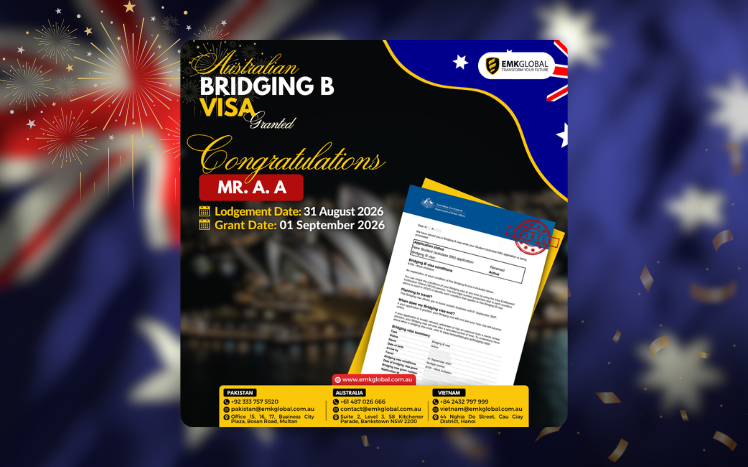
CONGRATULATIONS ON YOUR BRIDGING VISA B!

A very special congratulations to our client, Mr. A.A, on receiving his Bridging Visa B (BVB) in less than 24 hours!

With his visa granted, he can now travel overseas to be with his loved one and get married before returning to Australia.

For many visa holders, travelling overseas while an Australian visa application is being processed can be stressful and complicated. Getting the right advice and lodging the application correctly can make a big difference.

At EMK Global, we’re always happy to help our clients navigate their visa journey with care, clarity, and attention to detail.

Need to travel overseas while waiting for your visa? Contact the EMK Global team to discuss your situation and find out how we can assist.

Send us a message today!

EMK Global – Your Australian education & migration journey, supported.

#EMKGlobal #BridgingVisaB #BVB #AustralianVisa #VisaSuccess #AustraliaMigration #MigrationAustralia #StudyInAustralia #AustraliaVisa #VisaAssistance

August 31, 2026

February 2026 has been a pivotal month for both the Australian education and migration sectors, with several significant policy updates, regulatory changes, and emerging trends shaping student mobility, visa processes, and quality standards. These changes affect prospective and current students, education providers, and international recruitment stakeholders. 


Proposed Work-Rights Limit for Student Visa Holders 

A major policy proposal has gained significant attention in February: a call to limit student visa holders’ work rights to 60 hours per fortnight during term time. This proposal — floated publicly this month — would significantly tighten the already restricted work rights that international students currently enjoy while studying in Australia.  

Government and education sector stakeholders continue discussions about the potential impact on student finances, employment attraction, and Australia’s competitiveness as a global study destination. 


Tightened Student Visa Pathways & Genuine Student Test Changes 

In early February, Australian immigration authorities unveiled a suite of new student visa requirements aimed at strengthening the integrity of the system. These reforms include: 

  • Increased scrutiny of student visa applications 
  • Higher application fees 
  • More comprehensive genuine student tests to reduce visa misuse.  

While the full legislative details are underway, this shift signals a trend toward quality-over-quantity in international education entries, aligning Australia with global high-scrutiny systems. 


National Code Reform — Onshore Recruitment & Agent Commissions 

One of the most impactful changes this month has been an official amendment to the National Code of Practice for Providers of Education and Training to Overseas Students. 

The update prohibits providers from paying agent commissions for recruiting students already enrolled with another institution, with limited transitional exceptions.  

This reform aims to curb onshore poaching, improve compliance, and enhance transparency in agent-driven recruitment, affecting international student mobility and provider behaviour across the sector. 


Heightened Risk Classification for Indian Applicants 

In related international education news, Australia has re-classified India to the highest-risk migration assessment tier. This reclassification increases documentation scrutiny, requiring more robust proof of funds, clearer academic intent, and stronger genuine student evidence for applicants from India and the broader South Asian region.  

As the largest international student source market for Australia, this shift has implications for recruitment, application behaviours, and visa success projections. 


Quality Assurance Engagement & Sector Compliance Initiatives 

The Australian Skills Quality Authority (ASQA) has launched its 2026 sector engagement program, inviting education providers to face-to-face sessions focused on embedding the 2025 quality standards.  

This signals ongoing regulatory accountability and quality improvement throughout the vocational education and training (VET) sector, reinforcing Australia’s commitment to international education excellence. 


School Regulation Updates in NSW 

In education governance, the New South Wales Education Standards Authority (NESA) released its February 2026 School Registration Insights update. This includes revisions requiring explicit hate speech prohibitions in school staff conduct codes and updated manual resources for compliance.  

These changes emphasize professional standards and student welfare at the primary and secondary levels. 


Systemic Challenges: TAFE Workforce Concerns 

A newly published report has revealed concerning trends within the TAFE (Technical and Further Education) sector, where two-thirds of teachers are considering leaving the profession due to workload pressures, inadequate resources, and facility constraints.  

These systemic issues, reported amidst rising enrolments under Free TAFE incentives, highlight broader workforce sustainability pressures across Australia’s vocational education sector. 


What This Means for Education and Migration in 2026 

Together, these developments illustrate 2026 as a year of tightening standards, quality emphasis, and migration-policy recalibration: 

  • Stricter visa and recruitment compliance measures are being enforced.
  • Stakeholder debates around migration policy are intensifying with political positioning ahead of elections.
  • Education quality, integrity, and credential legitimacy remain priorities in regulatory agendas.
  • International student markets are facing greater scrutiny, particularly in major source regions.

Key Takeaways for Students & Providers

  • Expect stronger documentation requirements for student visas in 2026.
  • Agent and provider recruitment practices must align with the National Code reforms.
  • High-risk market applicants should prepare more rigorous evidence.
  • Quality compliance events (like ASQA engagement sessions) present opportunities for provider improvement.
  • Broader political migration policy discussions may influence future international student flows. 

Conclusion 

February 2026 has seen regulatory shifts that reflect Australia’s evolving approach to international education and migration — balancing integrity, quality, and sector sustainability. Whether you are a prospective student, agent, or education provider, understanding these changes is critical to planning a successful academic and migration pathway in Australia. 

August 27, 2026

VETASSESS has announced an upcoming increase to its Professional Skills Assessment fees, effective 9 September 2026.

According to VETASSESS, the fee adjustment is being made in line with movements in the Consumer Price Index (CPI) and has been reviewed in accordance with Australian Government guidance.

For applicants currently preparing a skills assessment, the upcoming change is an important deadline to be aware of.

Key Information at a Glance

Key Information Details
Fee increase effective from 9 September 2026
Applications received before 9 September 2026 Current fees will apply
Applications received from 9 September 2026 Updated fees will apply
Trade Occupation Assessments Not affected


Which Services Will Be Affected?

The fee increase will apply to Professional Skills Assessments and a number of related services.

These include Priority Processing (PP), Skills Assessment Support (SAS), Chinese Qualification Verification (CQV), Non-Migration Skills Assessments and Administration fees.

Importantly, VETASSESS has confirmed that the fee update does not apply to assessments for trade occupations.

Important Deadline: 9 September 2026

One of the most important points for applicants is that applications received by VETASSESS before 9 September 2026 will be charged at the current rates.

Applications received from 9 September 2026 onwards will be subject to the updated fees.

Therefore, applicants who are already ready to proceed with their assessment should carefully consider their application timeline and ensure their application is properly prepared before lodging.


Current Published VETASSESS Fees

VETASSESS currently lists the following fees for selected professional assessment services:

Service Applying from within Australia Applicant outside Australia
Full Skills Assessment AUD $1,205.60 AUD $1,096
Priority Processing* AUD $907.50 AUD $825
Points Test Advice AUD $342.10 AUD $311
485 Skills Assessment AUD $457.60 AUD $416

*Priority Processing is an additional fee on top of the Full Skills Assessment fee. Fees shown by VETASSESS may include or exclude GST depending on the applicant’s Australian tax residency status.

Applicants should check the official VETASSESS fee schedule before lodging, particularly around the 9 September 2026 fee change.


What Is a VETASSESS Skills Assessment?

A Skills Assessment is an important part of the professional occupation recognition process for people seeking to migrate to Australia.

VETASSESS assesses qualifications and employment experience to determine whether an applicant has the skills and knowledge required for their nominated occupation.

VETASSESS assesses a wide range of professional occupations across areas including:

  • Business and Finance
  • Arts and Education
  • Construction and Manufacturing
  • Hospitality and Retail
  • Science, Health and Agriculture


Why Is a Skills Assessment Important for Skilled Migration?

For several skilled migration pathways, applicants need to provide information about their skills assessment as part of the SkillSelect Expression of Interest (EOI) process.

The Department of Home Affairs states that applicants for skilled visas such as subclass 189, 190 and 491 need to submit an EOI before they can be invited to apply. Applicants also need a skills assessment in their nominated occupation before submitting their EOI.

However, having a positive skills assessment does not guarantee an invitation or visa grant. The Department of Home Affairs also makes clear that meeting the minimum points threshold does not guarantee an invitation, as invitation outcomes depend on the relevant program and selection process.


What Should Applicants Do Now?

If you are considering a skilled migration pathway and your occupation is assessed by VETASSESS, it is worth reviewing your situation before the fee change takes effect.

You should consider:

  • Checking whether VETASSESS is the relevant assessing authority for your nominated occupation.
  • Reviewing the qualification and employment requirements for your occupation.
  • Preparing your supporting documents carefully.
  • Checking that your employment history and qualifications can be properly evidenced.
  • If you are ready to lodge, being aware of the 9 September 2026 fee-change deadline.


Keep Your Migration Strategy Up to Date

A skills assessment is only one part of the overall skilled migration process. Your occupation, qualifications, work experience, English proficiency, points score and other circumstances can all affect your potential pathway.

The Department of Home Affairs also recommends keeping your EOI information up to date if your circumstances change, such as gaining additional work experience, obtaining a new qualification, improving your English proficiency or receiving a new skills assessment.


Need Help With Your Skills Assessment?

Planning your skills assessment carefully can help you avoid unnecessary delays and ensure that your qualifications and employment experience are presented appropriately.

📩 Contact EMK Global Education & Migration for assistance with reviewing your profile, understanding your potential skills assessment pathway and planning your next steps towards skilled migration in Australia.

Important: This article is provided for general information only and does not constitute migration or legal advice. VETASSESS assessment requirements, fees and Australian migration policies may change. Applicants should always check the latest information directly with VETASSESS and the Australian Department of Home Affairs.

Source: VETASSESS

December 11, 2023

A new migration strategy has been released by the Australian Government on 11 Dec 2023.

As part of this strategy, the government aims to help return migration to near pre-pandemic levels by next financial year, and introduce a number of new commitments to improved the overall outcomes of the migration program.

New Commitments to achieve Migration Strategy

1. New Skills in Demand visa

The Government will introduce a new 4-year temporary skilled worker visa—the Skills in Demand visa. The simpler and better targeted Skills in Demand visa will replace the complex single employer sponsored Temporary Skill Shortage (TSS) visa.

Key Features of the new visa will include:

  • Guaranteed pathways to permanent residence: Skills in Demand visa holders will have a pathway to permanent residence. Periods of employment with any approved employer will count towards permanent residence requirements. Temporary skilled migrants will also be enabled to apply for permanent residence through self-nominated independent pathways, for example, through a reformed points test.

  • More time to find a new job: If the employment relationship with a sponsor ceases, visa holders will have 180 days to find another sponsor and can work during this period.

  • Trailing employer fees: The Government will explore a model for employers to pay trailing charges and fees (e.g. monthly or quarterly) to make hiring a new migrant less onerous.

  • Public register of sponsors to assist mobility: A public register of approved sponsors, including the number of migrants sponsored and their occupations, will be developed to assist migrants wishing to find a new sponsor.

2. New Specialist Skills Pathway

The Specialist Skills Pathway is the first pathway within the Skills in Demand visa and will be available to applicants who meet the general eligibility criteria (for example, be nominated by an approved employer, meet the health and character requirements).

Key requirements are:

  • work in any occupation except trades workers, machinery operators and drivers, and labourers
  • 💰earning at least $135,000 (the Specialist Skills Threshold) and no less than Australian workers in the same occupation. The threshold income corresponds with the 90th percentile earnings for all workers in Australia

Processing Time: The Government will commit to a service standard of 7 days median visa processing time for workers in the Specialist Skills Pathway.

3. New Core Skills Pathway

The Core Skills Pathway is the second pathway in the new Skills in Demand visa and most temporary skilled migrants will come through the Core Skills Pathway.

Key requirements are:

  • occupation is on a new Core Skills Occupation List, which relates to occupations identified by Jobs and Skills Australia as being in shortage or where Australia has committed to providing access to our labour market in relation to that occupation through international trade agreements
  • paid a salary at or above the TSMIT (to be retitled the Core Skills Threshold, when the new system is implemented), or the relevant average market salary where it is above the TSMIT.

4. Legislate indexation of income thresholds to maintain system integrity

The Government will index the new Core Skills and Specialist Skills Thresholds in line with annual movements in Average Weekly Ordinary Time Earnings. This indexation requirement will be specified in legislation to provide clarity and predictability for migrants and employers, as recommended in the Migration Review.

5. Streamline labour market testing requirements to reduce complexity

The Government will immediately move to streamline labour market testing by removing the requirement to advertise positions through Workforce Australia and will subsequently increase the validity period from 4 to 6 months. As Jobs and Skills Australia’s role further matures, the Government will consider moving away from employer conducted labour market testing towards mechanisms for robust and genuine independent verification of labour market need.

6. Establish a best practice service level agreement for visa processing times and a modernised accreditation pathway to better compete for talent

The Government will establish a median service standard of 21 days for the new Skills in Demand visa and 7 days for the Specialist Skills Pathway.

The Government will aim to modernise the accreditation pathway, which will further help approved sponsors gain streamlined access to the migrant workers they need. These requirements for becoming an accredited sponsor favour large and established businesses, and disadvantage smaller businesses, especially start-ups, acting as a brake on innovation. The Government will open the accredited sponsor program to start-ups that have received venture capital from a registered venture capital fund. This will be balanced by strengthening integrity in the approved sponsor application process.

7. Reformed Points Test

The current points test used to select independent skilled migrants is complex and does not effectively attract migrants best able to contribute to Australia’s long-term prosperity. It includes factors which are likely to be poor predictors of success in the labour market, such as regional study or community language skills. Australia’s current points test also does not effectively capture age and skill trade-offs, despite both being strong predictors of migrant success and fiscal impact.

Secondary Applicant Skills: Grattan Institute has suggested that more consideration should be given to the skills of secondary applicants. Points offered via the test for different migrant characteristics should be re-calibrated to reflect the contribution those characteristics make to migrants’ contribution to the welfare of the Australian community.

Better Options for Graduate Working in Skilled Jobs: The reformed points test will also seek to better reward skill level over perseverance, which will mean for example, faster pathways for international student graduates who are working in skilled jobs in the labour market, but fewer pathways for graduates not working in skilled jobs.

Age, Experience and Education Re-Balancing: The Treasury estimates that a skilled migrant arriving at the age of 45 would need a starting salary of $160,000 to match the lifetime fiscal impact of a skilled migrant arriving at age 30 with a starting salary of $100,000. Balancing this out, some older migrants may have achieved high level skills which can deliver major economic benefits to the nation over their remaining working career. This might be better reflected in the reformed points test.

The Government will publish a discussion paper later in 2023 outlining the proposed approach to the redesign of the points test and will further consult on proposed changes. This will also consider impacts to State/Territory nominated and Regional visas, given these are points-tested visa programs.

8. Increased English Language Requirements for International Students

In early 2024, the Government will increase English language requirements for the Student and Temporary Graduate visas:

  • the test score required for a Temporary Graduate visa will increase from an International English Language Testing System (IELTS) score (or equivalent) of 6.0 to 6.5
  • the test score required for a Student visa will increase from IELTS (or equivalent) 5.5 to 6.0
  • the test score required for students undertaking an English Language Intensive Course for Overseas Students (ELICOS) before their main course of study will increase from IELTS (or equivalent) 4.5 to 5.0
  • the test score required for students undertaking university foundation or pathway programs that deliver reputable English language training will be IELTS (or equivalent) 5.5.

9. New Genuine Student Test

The government will replace the existing Genuine Temporary Entrant requirement to acknowledge that post-study temporary migration (and beyond) pathways are available for those who may be eligible. At the same time, the new Genuine Student test will be clear that the vast majority of international students in Australia will return home.

Two new Ministerial Directions will be introduced to support the integrity of processing in the student visa caseload.

The first Ministerial Direction will outline key areas of consideration to support decision makers, including the circumstances of the applicant, such as their academic or career progression and the usefulness of the intended study to their future career prospects. The Direction will be clear in setting the expectations of students who come to complete study in Australia. Those who do not meet those requirements will not be granted a student visa.

The second Ministerial Direction will focus on the prioritisation of processing the visa caseload. A processing priority Ministerial Direction will prioritise student visa applications based on risk-level of providers and will come into effect by the end of 2023, in time to support processing for the 2023–24 student visa peak season. Higher risk providers will experience slower processing times as visa decision makers consider the integrity of a provider, as well as the individual student applicants.

10. Improved DHA Student Visa Integrity unit to reduce misuse of Australia’s student visa system

To complement the introduction of the new Genuine Student test, the Government will invest $19 million to significantly bolster the student visa integrity unit in Home Affairs. This investment will allow for greater scrutiny at the point-of application to better identify non-genuine students and help build new analytical capabilities to identify students, facilitators and agents who misuse student visas post-arrival. This strengthened student visa integrity unit will also help support ASQA’s new integrity unit through cross-agency compliance activities.

11. Strengthen requirements for international education providers

The Government will act to assist regulators as they address unscrupulous provider behaviour through further legislative change. The Government will engage further with the sector in the development of its response and any implementation of these or similar measures.

This work will be complemented by the development of an International Education Strategic Framework. Working with the sector and the Council for International Education, the Government will ensure Australia’s valuable international education sector continues to prosper in delivering high quality education to genuine students.

12. Restrict onshore visa hopping

Australia’s student visa program has a proud history of attracting talented students from around the world. More recently, it has been used by some international students and other temporary visa holders to visa hop from visa to visa to extend their stay in Australia when they have little prospect of becoming permanent residents. This has contributed to a growing cohort of ‘permanently temporary’ former international students living in Australia.

Using the new Genuine Student test, the Government will require any eligible students applying inside Australia to provide evidence in their application to demonstrate that any subsequent course is furthering their career or academic aspirations, such as undertaking a practical VET course to complement their degree, or undertaking research to gain a Masters qualification in their field of expertise. Prospective international students who cannot demonstrate this sensible course progression from their initial course of study will not meet the Genuine Student test.

This change, combined with future proposed changes to the points test and other skilled visa settings, helps the graduates working in skilled jobs stay permanently, while reducing the number of graduates that are left in limbo and that stay despite having fewer prospects of permanent residence.

13. Strengthen and simplify Temporary Graduate visas

The government will introduce the following changes to Temporary Graduate Visas:

Shorter post-study work rights: The duration of an initial TGV will be shorter. The extension of post-study work rights will no longer be available. Only applicants who studied in a regional area will be eligible for an extension. TGV length under new settings will be:

Initial TGV

  • 2 years for Bachelor Degree
  • 2 years Masters by coursework
  • 3 years for Masters by research
  • 3 years for PhD

Eligibility for a second TGV

    • 1–2 years for study in a regional area (dependent on location)

Age Limitation: Maximum eligible age for a TGV will be reduced to 35.

Limited Graduate Visa Products: TGV streams will be re-named as Post-higher Education Work and Post-Vocational Education Work streams to be more descriptive for the relevant applicants. The Replacement Stream of the TGV and the subclass 476 visa will be abolished.

Clearer visa processing times: TGV processing times for the Post-Higher Education Work Stream will be backed by a 21-day service standard.

Clearer post graduate visa pathways: The work experience requirement for a Temporary Skills Shortage visa (and future Skills in Demand visa) will be changed to give TGV holders more opportunity to move on to a skilled visa. Proposed reforms to the points test will also give graduates working in skilled jobs faster pathways to permanent residency.

14. Develop a public register of approved sponsors to enable monitoring and oversight

The Government will develop a public register of employers who are approved to sponsor temporary migrant workers, to encourage public transparency, monitoring and oversight, and promote productivity-enhancing worker mobility. This will help migrant workers find new sponsors and give migrant workers a resource to check that a sponsoring employer is legitimate.

15. Longer Term Migration Planning Levels

The multi-year planning model, in collaboration with states will extend the planning horizon of the permanent Migration Program beyond its current 12 months and enable a better planning effort to meet the strategic, structural and long-term challenges that we face as nation and in our cities and regions.

16. Improved Skill Assessments and Recognition Procedures

There are currently 39 skilled migration assessing authorities approved by the Minister for Skills and Training to undertake skills assessments for 650 occupations. The government will implement new standards for skilled migration assessing authorities to optimise outcomes for Australian employers and migrants

17. Priority Processing for Regional Visas

The Government will immediately alter Ministerial Direction 100 to make visa processing for migrants sponsored by employers in regional Australia its top visa processing priority. This will help further streamline visa processing for businesses located in regional Australia who are sponsoring skilled workers.

18. Abolish unnecessary and duplicative visas to simplify the visa system

To start reducing the administrative burden, the Government will initially reduce the number of visa subclasses by 20, for example by merging offshore and onshore visa classes such as the subclass 101 Child visa (offshore) and the subclass 802 Child visa (onshore) into a single Child visa. We will close some temporary visas that are no longer receiving new applications and merge others that essentially perform the same purpose.

19. Improve Administration and Technology

Investment of $84m to reduce the visa backlog and visa processing times and Investment of almost $27.8m to improve the visa ICT system has been undertaken.

Read the full report here.

Source: Department of Home Affairs

November 27, 2023

CONGRATULATE NGUYEN THI NHU QUYNH FOR OBTAINING STUDENT VISA

– Visa submission date: November 07, 2023

– Biometrics: November 8, 2023

– Date of obtaining visa: November 8, 2023

As an independent girl, Nhu Quynh soon pursued her studies and had a stable career in Vietnam while her mother and younger brother were both in Australia with a Partner Visa. Holding an excellent degree when graduating from Ba Ria Vung Tau University in Logistics & Supply Chain Management, as well as achieving PTE 53, Quynh planned to study abroad at the Master’s level to develop her career in Australia.

For many reasons, Nhu Quynh has not been able to attach to her mother’s Partner application since 2020, she had to withdraw her application and seek support from EMK to apply for a Student Visa to pursue her study in Australia. Despite many risks due to her withdrawal from Partner Visa and no longer being bound to Vietnam, EMK still successfully helped her achieve Visa 500 in less than 1 month with the Master of Information System course at CQU with 25% scholarship for the entire course & 10 weeks of completely free EAP course.

November 27, 2023

CONGRATULATE MS. NGUYEN THI TRANG FOR CONQUERRING STUDENT VISA AFTER ONLY 4 DAYS OF FINGERPRINT BIOMETRICS

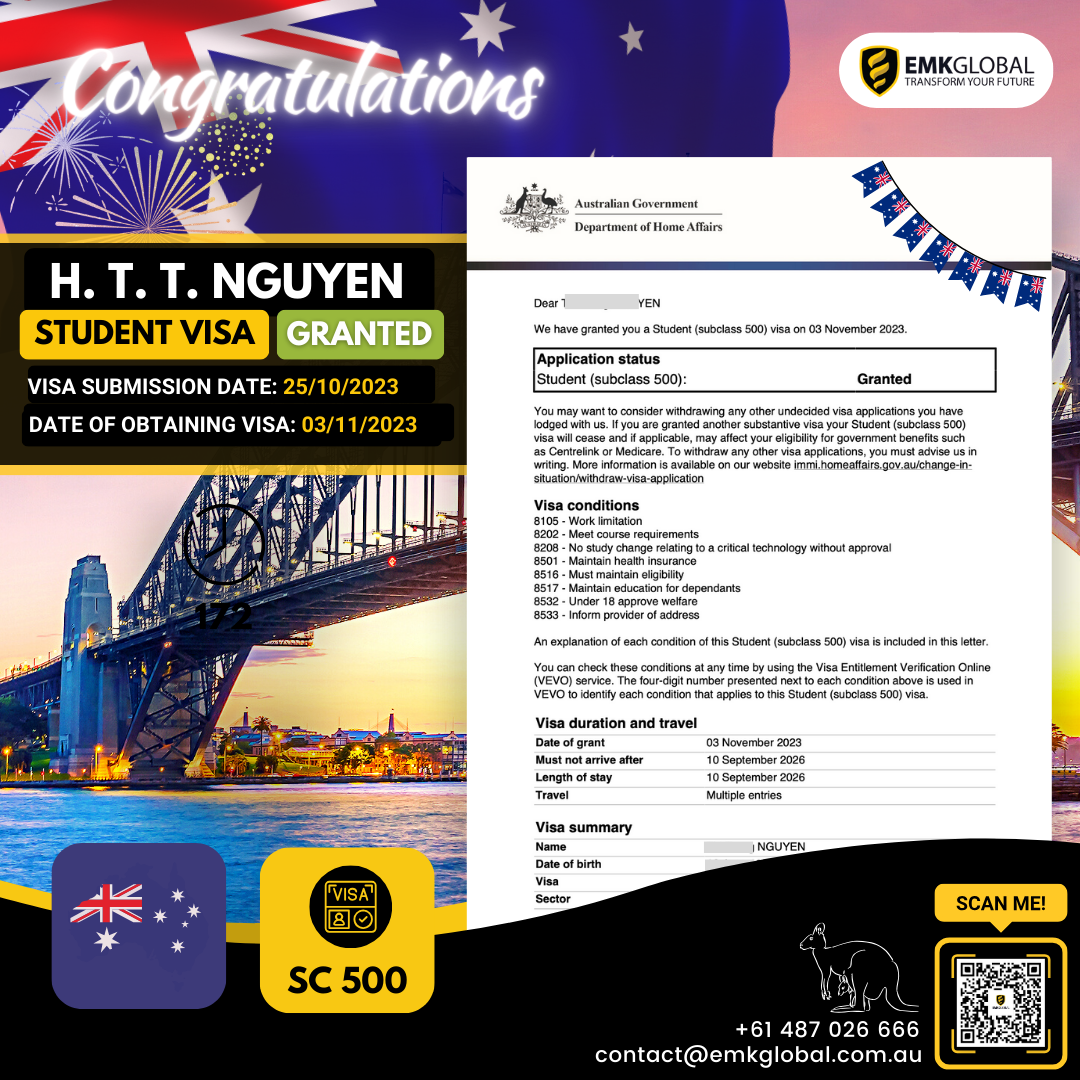
– Visa submission date: October 25, 2023

– Biometrics: October 30, 2023

– Visa date: November 3, 2023

– Course: Master of Business Management at Central Queensland University

– Scholarship: 25% of the entire course

Even though she already has a job as an Administrative Officer, Ms. Trang still wants to pursue her education and go further in her career with plans to study in Australia for a Master degree. Starting her journey to conquer higher education, Ms. Trang asked EMK for consulting support, as well as processing her application to study in Australia.

Facing many challenges such as risky place of birth & financial proof…, EMK successfully supported her to achieve Visa 500 and realize her dream of studying abroad with 7 pages of explanation to convince the LSQ just after 4 days of biometrics. EMK would like to wish Ms. Trang good luck and many achievements during her study in Australia.

November 27, 2023

CONGRATULATE MS. TRAN HUYEN CHI FOR OBTAINING STUDENT VISA (SUBCLASS 500)

– Visa submission date: October 23, 2023

– Date of obtaining visa: November 1, 2023

– Course: Master of Business Management at Central Queensland University

– Scholarship: 25% of the entire course

As a dynamic girl with a passion for the business field, Huyen Chi quickly chose to develop her career by studying abroad. Choosing EMK as her “companion” on the journey to Australia, she successfully received a scholarship of up to 25% for the entire Master of Business Management course at Central Queensland University.

However, unfortunately, Huyen Chi’s process of applying for an invitation letter encountered some problems, so it was not until October 21 that she received her COE even though she submitted her application 2 months in advance. With a relatively urgent admission schedule – November 6, EMK has tried its best to be able to apply for a Student Visa in time for Huyen Chi despite a few disadvantages in her profile regarding place of birth and proof of financial resources, as well as graduating from a university in section 2…

However, with her outstanding academic achievements, she successfully obtained a visa to study abroad to confidently embark on a new journey in Australia. EMK wishes Huyen Chi to study well and always go smoothly with all her future plans.

November 27, 2023

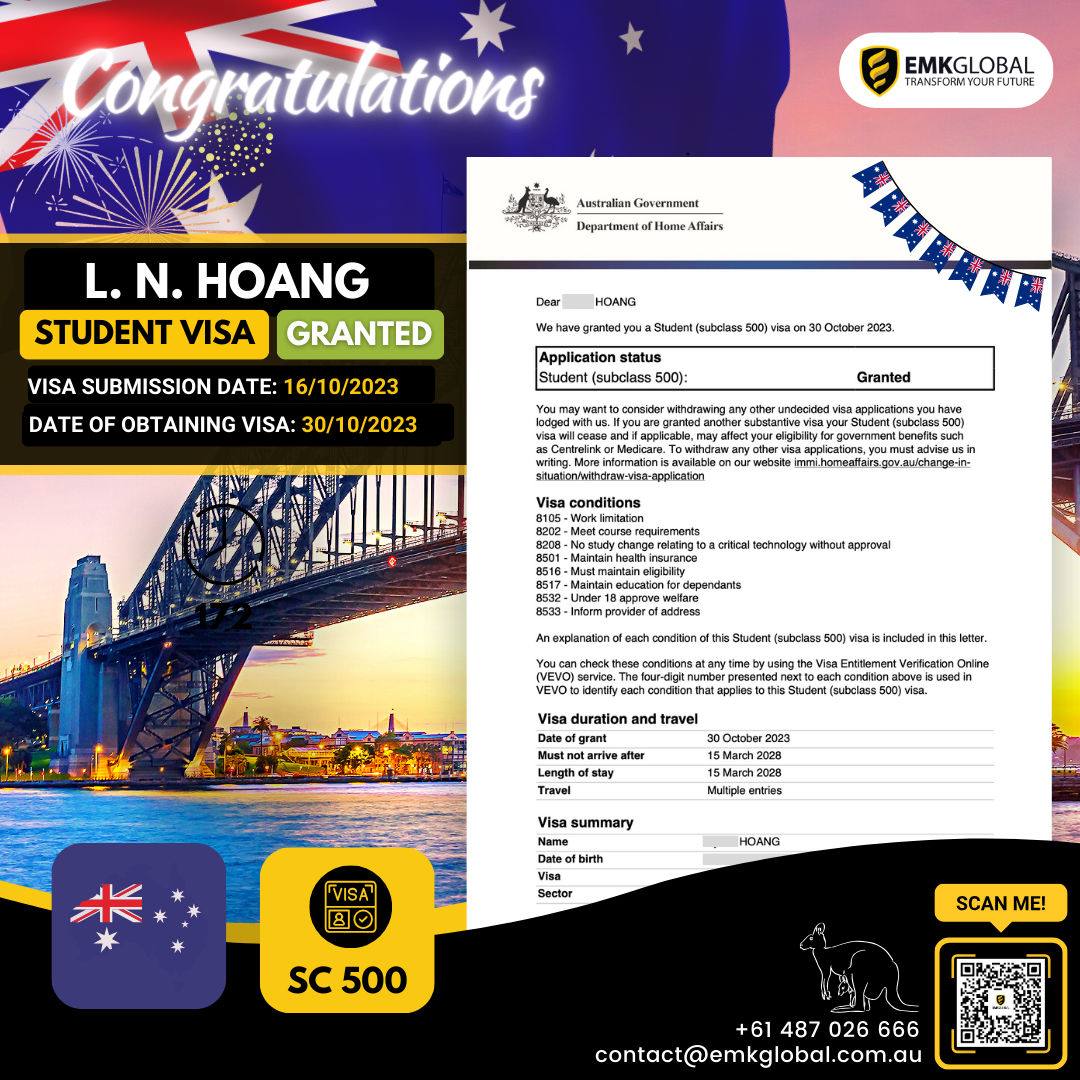
CONGRATULATE HOANG LY NA FOR SUCCESSFULLY OBTAINING STUDENT VISA AND 15% SCHOLARSHIP FROM TAFE NSW

Visa submission date: October 16, 2023

Visa date: October 30, 2023

Course: Bachelor of Early Childhood Education and Care at TAFE NSW

Scholarship: 15% of the entire course

Even though she had difficulty proving her finances because her family did not have a stable income, Ly Na always made efforts and wished to conquer education in new lands. With determination in her chosen study abroad path, Ly Na chose EMK to accompany her on her journey to Australia.

With enthusiastic encouragement and guidance from EMK, Ly Na successfully achieved the highest scholarship from TAFE NSW thanks to her good academic results, as well as an IELTS certificate. EMK wishes Ly Na to always be happy and maintain her enthusiasm to pursue her education and career in Australia. Hopefully TAFE NSW will be a solid steppingstone for her to achieve more success in the future.

November 27, 2023

CONGRATULATE NGOC ANH FOR OBTAINING STUDENT VISA (SUBCLASS 500)

Visa submission date: October 7, 2023

Biometrics: October 11, 2023

Visa issuance date: October 19, 2023

Course:

– Diploma of Business & Bachelor of Business Information Systems at Torrens University

– Scholarship: 20% of the entire course

With the desire to pursue higher education in Australia after completing 1 year of university in Vietnam, Ngoc Anh asked EMK Vietnam for support on the journey to Australia. Thanks to her proactiveness and willingness to coordinate with EMK, Ngoc Anh quickly obtained her visa to study abroad in less than 2 weeks.

EMK Vietnam would like to thank Ngoc Anh for choosing EMK to accompany her on her journey of studying abroad. And also on the occasion of October 20, we wish you will always be happy, healthy and have many memories and achievements in Australia!

November 27, 2023

Ha Linh’s family has difficulty in proving financial ability with risky place of birth, and she stops her study in Viet Nam to concentrate on preparing for her study abroad application. Previously, the family wanted to send her older sister to study abroad in Australia, but because of Covid 19, she had to stop her dream of studying abroad. Following her dream, the EMK team supported Linh to apply for a student visa at a public high school in VIC. After only 2 weeks of submitting the application, she had a Visa Grant to meet her enrollment date.

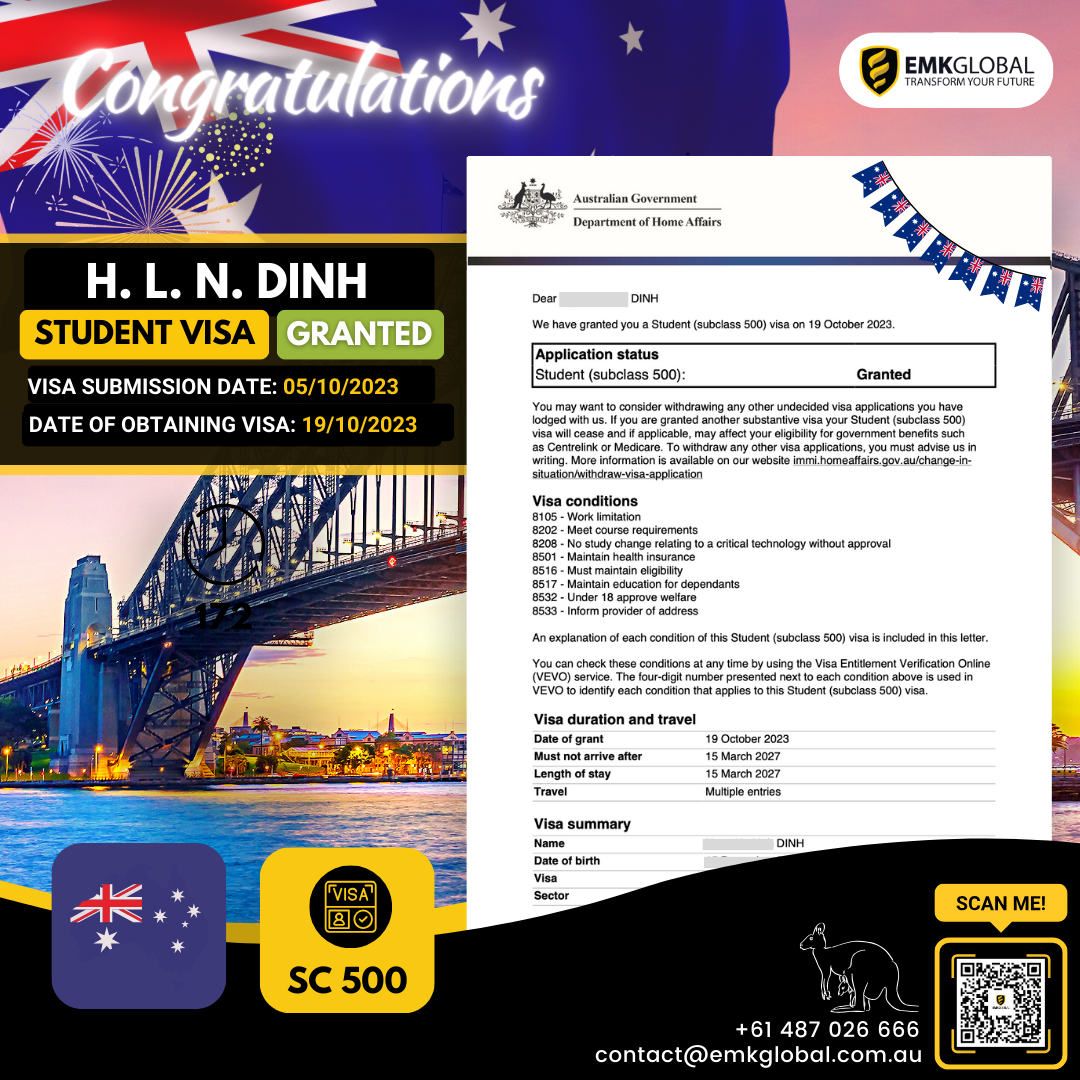
Date of health examination and biometrics: October 05, 2023

Date of enrollment: October 23, 2023

Date of receiving visa grant: October 19, 2023

This is actually quite a difficult period when applying to study in Australia at high school level because schools in most states are full, guardianship procedures are complicated, schools review applications strictly, and accommodation (homestay) is also limited. Therefore, when she got a visa quickly, EMK and his family felt very happy with this result.

Wish that Ha Linh will soon adapt to the new learning environment and have many memorable memories in the land of kangaroos!

November 27, 2023

CONGRATULATE MAI ANH FOR OBTAINING A STUDENT VISA

– Application date: September 18, 2023

– Visa issuance date: October 3, 2023

– Course: 10 weeks English and Master of Social Work (Qualifying) at Western Sydney University

– Scholarship: AU $6,000 for entire course

Although Mai Anh previously received a scholarship to study in the Netherlands, she still decided to change direction to improve her knowledge and develop her future in Australia. With the desire to find a course with a suitable tuition fee, EMK has supported her in applying for a 10-week English course and a Master of Social Work (Qualifying) course at Western Sydney University. In particular, EMK Vietnam supported Mai Anh to apply for a scholarship worth $6,000 for the entire course to make her journey to Australia as smooth as possible. Even luckier, it was a surprise when Mai Anh received her visa just 5 HOURS before boarding the plane.

EMK team wishes you good luck and success in Australia.

November 27, 2023

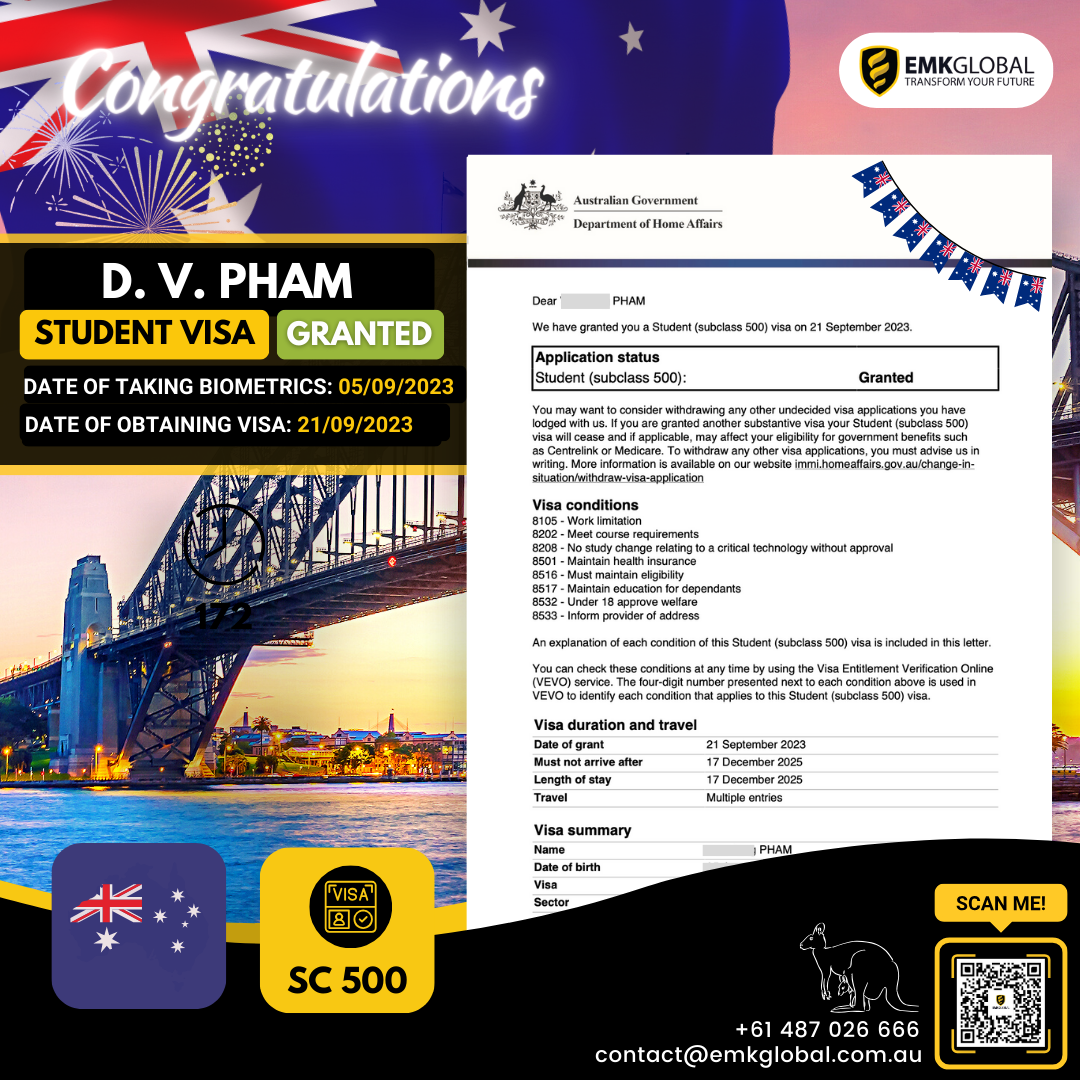
CONGRATULATE DUNG FOR SUCCESSFULLY APPLYING FOR A STUDENT VISA

– Date of taking biometrics: September 5, 2023

– Health examination date: September 7, 2023

– Visa issuance date: September 21, 2023

– Course: Master of Business in Global Hotel Leadership – The Hotel School

– Scholarship: AU $6,000 for entire course

Although the courses and previous experiences were not related to the field of study that Dung chose at The Hotel School, EMK Vietnam successfully supported Viet Dung to not only obtain a Study Abroad Visa (Subclass 500) but also receive a 22% scholarship for the entire course.

Hopefully in the future, Viet Dung will have a wonderful time in Australia and further develop in his career! EMK Vietnam sincerely thank you!