Victoria ranks subclass 190 and 491 ROIs using seven weighted factors. Explore the points tables, partner requirements and how the VPT differs from SkillSelect.



Victoria ranks subclass 190 and 491 ROIs using seven weighted factors. Explore the points tables, partner requirements and how the VPT differs from SkillSelect.
The changes affect applicants across management, engineering, science, education, healthcare, business and trade occupations.
NSW confirms that the update applies to subclass 190 only. A separate update on the NSW Regional Skills List for subclass 491 will follow when further information becomes available.
The following groups have been added, creating potential opportunities for applicants whose specific occupations meet the relevant requirements.
| ANZSCO Code | Occupation Group |
| 1213 | Livestock Farmers |
| 2241 | Mathematical Science Professionals |
| 2251 | Advertising and Marketing Professionals |
| 2325 | Interior Designers |
| 2413 | Middle School Teachers / Intermediate School Teachers |
| 2415 | Special Education Teachers |
| 2492 | Private Tutors and Teachers |
| 2493 | Teachers of English to Speakers of Other Languages |
| 2511 | Nutrition Professionals |
| 2523 | Dental Practitioners |
| 2526 | Podiatrists |
| 2612 | Multimedia Specialists and Web Developers |
| 3221 | Metal Casting, Forging and Finishing Trades Workers |
| 4114 | Enrolled and Mothercraft Nurses |
| 4523 | Sports Coaches, Instructors and Officials |
The following groups no longer appear on the updated NSW subclass 190 Skills List.
| ANZSCO Code | Occupation Group |
| 1325 | Research and Development Managers |
| 1332 | Engineering Managers |
| 1334 | Manufacturers |
| 1343 | School Principals |
| 1351 | ICT Managers |
| 2321 | Architects and Landscape Architects |
| 2326 | Urban and Regional Planners |
| 2331 | Chemical and Materials Engineers |
| 2334 | Electronics Engineers |
| 2335 | Industrial, Mechanical and Production Engineers |
| 2342 | Chemists, and Food and Wine Scientists |
| 2343 | Environmental Scientists |
| 2344 | Geologists, Geophysicists and Hydrogeologists |
| 2421 | University Lecturers and Tutors |
| 2513 | Occupational and Environmental Health Professionals |
| 2611 | ICT Business and Systems Analysts |
Start by checking your exact occupation and ANZSCO code.
NSW publishes its list at the four-digit ANZSCO Unit Group level. Inclusion of a group does not make every occupation within it eligible: your specific occupation must also qualify for subclass 190 under Home Affairs requirements.
For example, applicants should distinguish between an occupation group’s broad title and the specific occupation assessed in their skills assessment.
Review your plans before relying on NSW subclass 190 nomination.
Removal from this state list should not be interpreted as removal from every Australian skilled migration pathway. Other options require a separate assessment against their own occupation lists and eligibility criteria.
Avoid changing your nominated occupation simply to match a listed group without first checking whether your qualifications, experience and skills assessment support that occupation.
NSW nomination is competitive and invitation-based. Applicants cannot apply directly for nomination.
NSW considers factors including age, English proficiency, qualifications, points and skilled employment experience. Applicants must also meet the relevant visa, skills assessment and residency requirements.
If invited to apply for NSW nomination, applicants have 14 days to submit their application with valid evidence supporting their EOI claims. NSW states that this deadline cannot be extended.
Use the updated list as a prompt to review:
Has your occupation group been added or removed?
EMK Global Education & Migration can help you understand how the updated list relates to your circumstances and review the next steps in your skilled migration plans.
Contact our team to discuss your options.
Disclaimer: This information is provided for general information and educational purposes only. It does not constitute immigration or legal advice. Visa requirements and policies may change, and individual circumstances vary. Please seek advice from a registered migration agent or qualified professional before making any visa or immigration decisions.
Source: NSW Government
Applicants have shared invitation scores across trades, healthcare, education, engineering and other occupations following the 15 October 2026 subclass 189 round. View the reported points and understand their limitations.
Australia plans to introduce a new Student Visa Transfer Stream from 1 July 2027, requiring international students who change education providers to obtain a new Student Visa before commencing their studies with the new provider.
The Australian Government has announced significant reforms to the Student Visa (subclass 500) program, including changes to how international students can transfer between registered education providers.
Under the proposed framework, students seeking to change providers after arriving in Australia will be required to apply through a new Student Visa Transfer Stream.
The reform is scheduled to commence on 1 July 2027, following a temporary increase in the existing student transfer restriction period from six to 12 months.
However, the Department of Home Affairs and Study Australia have confirmed that further details of the Transfer Stream are still being developed.
Here is what international students should know about the announced changes and how they may affect future study plans.
The Student Visa Transfer Stream is a new pathway planned within Australia’s existing Student Visa (subclass 500) framework.
Its purpose is to regulate transfers between education providers more closely and ensure that students changing providers continue to meet the requirements of the Student Visa program.
Under the announced arrangements, international students who wish to transfer to another education provider after arriving in Australia will be required to apply for a new Student Visa through the Transfer Stream.
The Australian Government has confirmed that students will need to receive their new visa before commencing studies with the new provider.
This represents a significant change from the current arrangements, where a provider transfer does not necessarily require a new Student Visa application.
The Government has announced 1 July 2027 as the intended commencement date.
Until then, the existing National Code transfer framework continues to operate, subject to the temporary 12-month restriction introduced on 2 October 2026.
| Period | Transfer arrangements |
| Before 2 October 2026 | General six-month restriction for transfers between registered providers |
| 2 October 2026 – 30 June 2027 | Temporary 12-month restriction for non-school students |
| From 1 July 2027 | Transfer restriction scheduled to return to six months, alongside the planned Student Visa Transfer Stream |
The Department of Education has confirmed the temporary amendment to the National Code.
The new Transfer Stream is a separate immigration reform, with further operational details yet to be published.
Yes, under the announced 2027 framework.
The Australian Government has stated that students seeking to change education providers after arriving in Australia will need to apply for a new Student Visa through the Transfer Stream.
Importantly, students will need to wait until the new visa has been granted before commencing their course with the receiving provider.
For example:
A student currently enrolled at University A wishes to transfer to University B after the new arrangements commence.
Under the announced framework, the student would need to satisfy the applicable transfer requirements and obtain the relevant Student Visa approval before beginning studies at University B.
However, the Government has not yet published the complete application process or detailed eligibility criteria.
Students should therefore avoid assuming that the current transfer procedures will remain unchanged after July 2027.
One important feature of the announced Transfer Stream concerns visa validity.
According to the Australian Government’s official announcement on 2 October 2026, the new Student Visa granted through the Transfer Stream will retain the end date of the original visa.
For example:
A student holds a Student Visa valid until 30 June 2029.
If the student changes providers under the new Transfer Stream in 2027, the Government’s announced policy indicates that the replacement visa would retain the original visa’s expiry date.
This means students should not assume that transferring to another education provider will automatically extend their permitted stay in Australia.
Any further study extending beyond the existing visa validity period may require separate consideration under the applicable Student Visa rules.
The Australian Government has announced tighter restrictions on transfers involving the Australian Qualifications Framework (AQF).
Under the planned reforms, transfers will generally be permitted at the same AQF level or to a higher AQF level, rather than to a lower level.
The Government has also specifically announced restrictions on students entering Australia for Higher Education and subsequently transferring onshore to Vocational Education and Training (VET).
For example:
| Proposed transfer | Announced policy direction |
| Bachelor Degree (AQF 7) → Bachelor Degree (AQF 7) | Same-level progression |
| Bachelor Degree (AQF 7) → Master Degree (AQF 9) | Higher-level progression |
| Master Degree (AQF 9) → Bachelor Degree (AQF 7) | Downward AQF transfer |
| Bachelor Degree (Higher Education) → VET Diploma (AQF 5) | Lower-level transfer and Higher Education-to-VET movement |
The first two examples align with the announced direction of same-level or higher-level transfers.
The latter examples illustrate the types of movements the Government intends to restrict.
However, students should not interpret these examples as automatic visa eligibility decisions. The final Transfer Stream criteria, including how different education sectors and qualifications will be assessed, have not yet been fully published.
Before the new Transfer Stream commences, international students must comply with the existing transfer rules under the National Code of Practice for Providers of Education and Training to Overseas Students 2018.
From 2 October 2026, the Australian Government temporarily extended the general transfer restriction period for non-school students from six months to 12 months of their principal course.
The temporary arrangement will remain in place until 30 June 2027.
During this period, a receiving education provider generally cannot enrol a transferring international student before the required period has passed unless an applicable exception is satisfied.
Exceptions may include circumstances where:
The restriction is not an absolute prohibition on transfers during the first 12 months.
School students remain subject to the existing six-month restriction for their first registered school-sector course.
The key difference is the additional Student Visa requirement.
Current framework – October 2026 to June 2027
Students must satisfy the applicable National Code transfer requirements.
Depending on their circumstances, a provider transfer may be possible without applying for a new Student Visa.
Announced framework – from July 2027
Students seeking to change providers after arriving in Australia will be required to apply for a new Student Visa through the Transfer Stream.
The new visa must be granted before they commence studying with the receiving provider.
The visa’s original expiry date will be retained under the announced policy.
This means students will need to consider both education-provider transfer requirements and immigration requirements when planning a transfer.
The Study Australia guidance published on 7 October 2026 confirms that the Government is still developing the detailed Transfer Stream arrangements.
It does not provide a complete set of transitional rules for every student who has already changed providers or is in the process of transferring.
Students should therefore avoid assuming that all previously approved transfers will be treated identically under the future framework.
Existing Student Visas remain subject to their current conditions, and students should continue complying with the rules applicable to their enrolment and visa circumstances.
The Government has not yet confirmed a specific application charge for the new Transfer Stream.
As of 12 October 2026, official guidance has not published the full fee structure, detailed application process or complete assessment criteria.
It would therefore be premature to assume that the Transfer Stream will have the same application charge as a standard Student Visa application.
Students should wait for further information from the Department of Home Affairs before making financial decisions based on anticipated Transfer Stream costs.
Students considering a transfer in 2026 or 2027 should carefully review their study pathway and visa circumstances.
Before proceeding, they should:
Australia’s proposed Student Visa Transfer Stream, scheduled to commence on 1 July 2027, represents a significant change to the way international students transfer between education providers.
Under the announced framework:
However, the full operational details remain under development.
International students should monitor official announcements and carefully assess their education and visa arrangements before changing providers.
EMK Global Education & Migration assists international students with education pathways, course selection and understanding the implications of changing education providers.
If you are considering transferring to another institution or progressing to a new qualification, contact EMK Global to discuss your study options and obtain guidance relevant to your circumstances.
Disclaimer: This information is provided for general information and educational purposes only. It does not constitute immigration or legal advice. Visa requirements and policies may change, and individual circumstances vary. Please seek advice from a registered migration agent or qualified professional before making any visa or immigration decisions.
Source: Australia Governement, Study Australia & Department of Education
Australia introduced new Student Visa family member restrictions on 2 October 2026. Find out which international students can still include their spouse, partner or dependent children, how transitional arrangements work and what the changes mean for subsequent entrant applications.

Learn how the Victorian Points Test (VPT) ranks skilled visa applicants for subclass 190 and 491 nomination in 2026–27. Explore the seven ranking factors, scoring tables, invitation pathways and priority industry selection process.
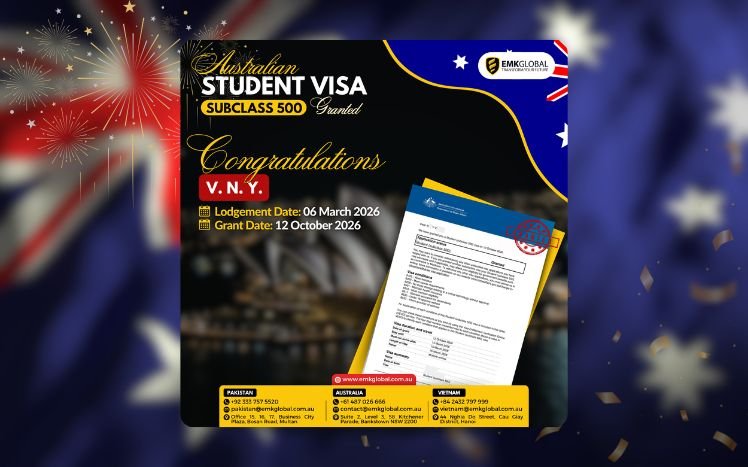
V.N.Y has successfully received her Australian Student Visa grant on 12 October 2026 after more than seven months of waiting. With support from EMK Global Vietnam, she can continue her Bachelor of Tourism and Hospitality Management at AAPoly and pursue her academic and professional goals in Australia.
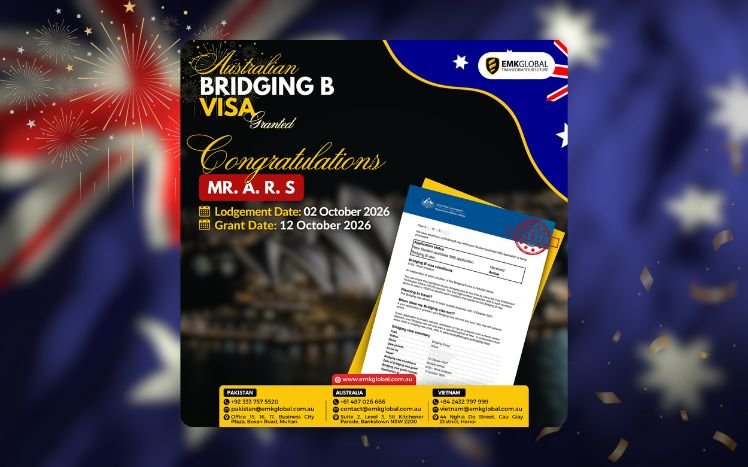
EMK Global shares a successful Bridging Visa B outcome for Mr. A.R.S., whose visa was granted approximately two hours after an urgent processing request was submitted ahead of his scheduled overseas flight. Learn more about the case and how EMK Global supports clients with time-sensitive Australian visa matters.
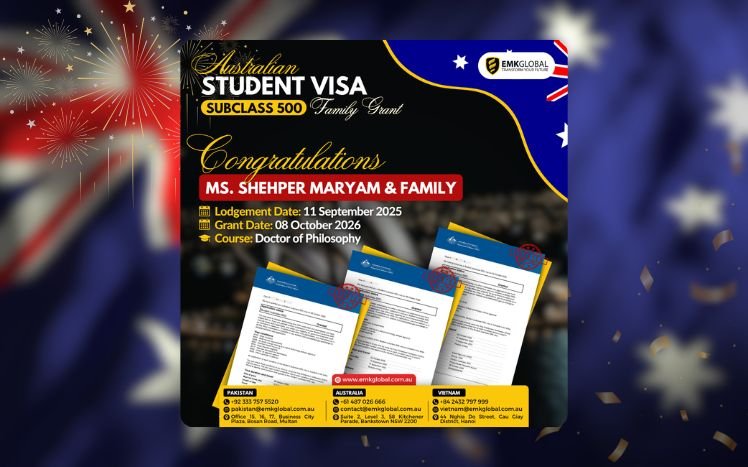
Congratulations to Ms. Shehper Maryam Zafar on securing her Australian Student Visa to pursue a PhD at Central Queensland University (CQU). Discover how EMK Global supported her application journey as she prepares to begin a new chapter in Australia with her family.
Australia has introduced a significant change to the rules governing international student transfers between education providers.
From 2 October 2026, most international students outside the school sector are temporarily required to complete at least 12 months of their principal course before another registered provider can enrol them, unless an exception applies.
Previously, the general transfer restriction period was six months.
The change forms part of amendments to the National Code of Practice for Providers of Education and Training to Overseas Students 2018 (National Code) and will operate as a temporary measure until 30 June 2027. From 1 July 2027, the restriction period is scheduled to return to six months.
The Australian Government amended Standard 7 of the National Code, which regulates transfers between registered education providers.
Under the amended Standard 7.1, a receiving provider generally must not knowingly enrol an overseas student transferring from another registered provider unless the required transfer restriction period has passed.
The rules are now:
| Student category | Transfer restriction |
| Non-school students until 30 June 2027 | 12 months of the principal course |
| Non-school students from 1 July 2027 | 6 months of the principal course |
| School students | First 6 months of the first registered school sector course |
The 12-month restriction therefore applies temporarily to most non-school international students, including students in higher education and VET.
The legislative instrument was registered on the Federal Register of Legislation on 1 October 2026 and commenced the following day, 2 October 2026. It is currently listed as in force.
The Department of Education has also published separate guidance for international students explaining the temporary extension from six to 12 months.
Not necessarily.
The change does not create an absolute ban on transfers during the first 12 months.
Under the amended Standard 7.1A, a receiving provider may enrol a student during the restricted period in specified circumstances, including where:
Therefore, the correct interpretation is not that international students are completely prohibited from changing providers during their first 12 months.
Rather, students who have not completed the required period generally need to satisfy one of the exceptions, such as obtaining an approved release from their existing provider.
This is particularly important for students already studying in Australia.
The amendment changes the restriction period to 12 months for non-school students on or before 30 June 2027. It is not limited only to students who commence their course after 2 October 2026.
As a result, a student who had completed more than six months but less than 12 months of their principal course when the new rule commenced may again fall within the transfer restriction period.
For example, completing seven or eight months of a principal course does not automatically mean a student can now transfer freely simply because they had already passed the previous six-month threshold.
Their circumstances should be checked against the amended Standard 7 before proceeding with a transfer.
No.
The Government has specifically retained the existing rule for school students.
Where the releasing provider is an approved school provider, the restriction continues to apply during the first six months of the student’s first registered school sector course.
The temporary increase to 12 months therefore applies to non-school students.
The 12-month period relates to the student’s principal course, rather than simply 12 months from the date the student first arrived in Australia.
This distinction can be particularly important for students with packaged courses.
Students should therefore confirm which course is recorded as their principal course and when that course commenced before determining whether they have satisfied the transfer restriction period.
The Australian Government describes the measure as part of broader reforms designed to strengthen the integrity of the international education and Student visa system.
In its official announcement on 2 October, the Government described the 12-month rule as a transition measure operating until the introduction of further transfer reforms from 1 July 2027.
The Government has stated that the reforms are intended to address inappropriate visa hopping and problematic transfer practices while maintaining pathways for genuine transfers.
The current 12-month rule is temporary.
Under the amended National Code, the general transfer restriction period for non-school students will return to six months from 1 July 2027.
However, another major reform is also planned from that date.
The Government has announced that students seeking to transfer to another provider will need to obtain a new Student visa through a transfer stream before commencing study with the new provider.
The Government has also stated that the new visa will retain the end date of the original visa.
In addition, the announced transfer framework is intended to allow students to move across the same AQF level or to a higher level, rather than transferring down the AQF. The Government has specifically stated that students will no longer be able to transfer onshore from Higher Education to VET under this framework.
These 1 July 2027 arrangements should be distinguished from the 12-month rule already operating now.
Students considering a provider transfer should not cancel their current enrolment or commence with another provider solely on the assumption that the old six-month rule still applies.
They should first establish:
The Department of Education has published specific guidance for students following the commencement of the new rules.
From 2 October 2026 to 30 June 2027, most non-school international students are subject to a 12-month transfer restriction period for their principal course, replacing the previous six-month period.
However, this does not mean all transfers during the first 12 months are prohibited. Transfers can still occur in specified circumstances, including where the existing provider approves a release in accordance with Standard 7.
From 1 July 2027, the National Code restriction is scheduled to return to six months, alongside broader Student visa transfer reforms announced by the Australian Government.
EMK Global Education & Migration can assist international students in reviewing their current enrolment, transfer eligibility and study options before changing education providers.
Disclaimer: This information is provided for general information and educational purposes only. It does not constitute immigration or legal advice. Visa requirements and policies may change, and individual circumstances vary. Please seek advice from a registered migration agent or qualified professional before making any visa or immigration decisions.
Source: Department of Education

The Australian Department of Home Affairs has reminded visa applicants and current visa holders of the importance of maintaining adequate health insurance throughout their stay in Australia.
Depending on the visa subclass and applicable conditions, health insurance may be a mandatory requirement for obtaining or holding an Australian visa.
The reminder is not a new immigration policy. Instead, it highlights existing obligations and encourages visa holders to review their insurance arrangements to ensure they remain compliant with their visa conditions.
Health insurance requirements vary depending on the type of Australian visa.
For some visas, applicants must provide evidence of adequate health insurance arrangements before their visa can be granted. Other visas are subject to Condition 8501 – Maintain Adequate Health Insurance.
Under Condition 8501, visa holders must maintain adequate health insurance while they are in Australia.
This condition is mandatory for certain visa subclasses and may be imposed at the Department’s discretion for others.
Visa holders should check their individual visa grant letter or use the Department of Home Affairs’ Visa Entitlement Verification Online (VEVO) service to confirm their requirements.
Several temporary visa categories are subject to health insurance requirements.
| Visa subclass | Health insurance considerations |
| Student Visa (500) | Overseas Student Health Cover (OSHC) is required. |
| Temporary Graduate Visa (485) | Adequate health insurance is required under Condition 8501. |
| Skills in Demand Visa (482) | Adequate health insurance is required under Condition 8501. |
| Training Visa (407) | Condition 8501 applies. |
| Student Guardian Visa (590) | Health insurance requirements apply. |
| Visitor Visa (600) | Condition 8501 may be imposed in certain circumstances. |
| Working Holiday Visas (417/462) | Condition 8501 may apply depending on the visa grant. |
Applicants should not assume that all temporary visas have identical insurance requirements.
The appropriate insurance product will depend on the visa subclass, visa conditions and individual circumstances.
International students holding a Student Visa (subclass 500) are subject to Condition 8501 and must maintain Overseas Student Health Cover (OSHC) while in Australia.
OSHC helps international students meet their health insurance obligations and provides access to certain medical and hospital benefits.
Students should ensure that their OSHC arrangements cover the required period of their stay, including when they extend their studies or apply for another Student Visa.
It is particularly important to review insurance arrangements when:
Students should also understand that OSHC does not necessarily cover every medical expense. Benefits, exclusions and out-of-pocket costs vary between policies.
According to the Department of Home Affairs, adequate private health insurance should generally provide protection for essential medical and hospital services.
Recommended coverage includes:
The Department recommends reviewing the policy carefully to determine whether the benefits meet both the applicable visa requirements and the individual’s healthcare needs.
For many temporary visa holders who are not international students, Overseas Visitor Health Cover (OVHC) is a common form of private health insurance.
OVHC may be suitable for eligible temporary workers, graduates and other visitors, depending on the product and applicable visa conditions.
However, not all OVHC products provide the same benefits or satisfy every visa requirement.
Before purchasing insurance, applicants should confirm that their selected policy meets any applicable Condition 8501 requirements.
Australia’s public healthcare system, Medicare, provides access to subsidised medical services for eligible individuals.
However, most temporary visitors are not automatically eligible for Medicare.
Without Medicare or adequate private health insurance, individuals may be responsible for significant medical expenses, including treatment received in public hospitals.
Some temporary residents may qualify for Medicare through specific eligibility arrangements, including Reciprocal Health Care Agreements.
Nevertheless, Medicare eligibility does not automatically remove a visa holder’s obligation to comply with Condition 8501.
The Department of Home Affairs also advises that outstanding healthcare debts may be considered in future visa applications.
Selecting health insurance should involve more than comparing monthly premiums.
Visa holders should review the following:
Ensure the insurance remains active for the required period and that premiums are paid on time.
Some policies impose waiting periods before benefits become available for certain treatments, including pre-existing medical conditions and pregnancy-related services.
Check whether the policy excludes particular treatments, medications or medical services.
Understand any excess, co-payment or patient contribution that may apply when receiving treatment.
Where relevant, confirm that eligible dependants have appropriate insurance arrangements.
Reviewing these details can help visa holders avoid unexpected medical expenses and potential issues with their visa conditions.
Where Condition 8501 applies, maintaining adequate health insurance is a visa obligation.
Failing to maintain the required insurance may constitute a breach of visa conditions and could have immigration consequences.
The outcome will depend on the individual’s circumstances and applicable legal requirements. A lapse in insurance should not be interpreted as automatically resulting in visa cancellation.
Visa holders who discover a gap in their insurance coverage should contact their insurer promptly and seek appropriate advice.
The Department of Home Affairs’ reminder reinforces an important responsibility for Australian visa applicants and temporary visa holders: health insurance requirements should be reviewed and maintained throughout the relevant period of stay in Australia.
For international students, this generally means maintaining appropriate OSHC.
For other temporary visa holders, adequate private health insurance, often through an OVHC product, may be required depending on their visa conditions.
Understanding these obligations can help individuals remain compliant with their visa requirements while protecting themselves against unexpected healthcare expenses.
EMK Global Education & Migration assists international students and prospective visa applicants in understanding their study and visa pathways in Australia.
If you are applying for a Student Visa, extending your studies or reviewing your visa arrangements, contact EMK Global for assistance with your circumstances.
Disclaimer: This information is provided for general information and educational purposes only. It does not constitute immigration or legal advice. Visa requirements and policies may change, and individual circumstances vary. Please seek advice from a registered migration agent or qualified professional before making any visa or immigration decisions.
Source: Department of Home Affairs
Australia has introduced significant changes to Student visa (subclass 500) application rules from 2 October 2026, affecting where many applicants can lodge their visa application and where they must be when the visa is granted.
Under the new rules, most Student visa applications must now be lodged from outside Australia. This includes many temporary visa holders and, importantly, most current Student visa holders seeking to apply for another Student visa.
However, limited exemptions remain available for certain existing Student visa holders, including some students progressing to a higher level of study, PhD students, students affected by provider default and students requiring additional time to complete their existing course.
The changes apply to applications lodged from 2 October 2026. Applications lodged before this date continue to be assessed under the rules that applied when they were submitted.
The new rules significantly restrict the circumstances in which a Student visa applicant can lodge another Student visa application while remaining in Australia.
Home Affairs states that most applicants must now apply from outside Australia. An applicant can only apply in Australia where they hold an eligible visa and satisfy an applicable exemption.
For applicants who are required to apply offshore, there are two important location requirements:
This means the new rules affect not only where an application can be submitted, but potentially the applicant’s travel and study planning while the application is being processed.
The rules are particularly strict for holders of affected temporary visas.
Home Affairs states that where a person holds an affected temporary visa other than a Student visa, there are no exemptions allowing them to lodge the Student visa application in Australia.
They must apply from outside Australia and must also be outside Australia when the Student visa is granted.
Applicants should therefore check their current visa subclass before enrolling in a new course or making travel and financial commitments.
In most cases, a current Student visa holder seeking another Student visa will now need to apply from outside Australia.
However, unlike holders of other affected temporary visas, current Student visa holders may qualify for specific exemptions allowing them to lodge another Student visa while remaining in Australia.
Home Affairs currently identifies exemptions including students who:
These exemptions are important, but applicants should not assume that simply enrolling in another course is sufficient to qualify.
One of the most significant exemptions concerns students who have completed a course and wish to progress to further study.
Where the completed main course has an Australian Qualifications Framework (AQF) level, the new course must generally be at a higher AQF level for the student to rely on the course progression exemption and apply for another Student visa in Australia.
There is also an additional requirement for students moving between higher education courses.
Home Affairs states:
If the completed course was a higher education course, the next course must also be a higher education course delivered by a higher education provider.
This means students considering changing or extending their study pathway should carefully examine both the AQF level and the type of education provider before assuming they can lodge their next Student visa onshore.
The rules are particularly clear in this situation.
If a person currently holds a Student visa as a dependant and wants to lodge a new Student visa as the primary applicant, they must:
Home Affairs specifically confirms that there are no exemptions to this rule.
Importantly, this does not cancel or otherwise change the person’s existing Student visa. The new location requirement applies when they seek to lodge a new application as the primary applicant.
This is one of the most important practical consequences of the reform.
Home Affairs warns that if an applicant lodges a Student visa application in Australia when the rules require them to be offshore, the application will be invalid.
An invalid application can create further complications, particularly where the person’s existing visa expires.
For this reason, applicants should establish whether they are eligible to lodge onshore before submitting a new Student visa application.
Can You Return to Australia While an Offshore Student Visa Is Processing?
Potentially, yes.
Home Affairs states that an applicant who has lodged their Student visa from outside Australia may return to Australia on another valid visa while the Student visa application is being processed.
However, where the offshore location requirement applies, the applicant must again be outside Australia when the Student visa is granted.
Another important difference is that an offshore Student visa application does not provide a Bridging visa linked to that application.
Applicants should therefore carefully consider their lawful status and travel arrangements while waiting for a decision.
The new rules are not applied retrospectively to Student visa applications already lodged before commencement.
Home Affairs confirms that applications lodged before 2 October 2026 will continue to be assessed under the rules that applied when the application was made.
This also applies to applications lodged before the commencement date that included eligible family members.
The changes make forward planning increasingly important for students approaching the end of their current course or Student visa.
Before enrolling in another course or lodging another Student visa application, students should check:
Home Affairs specifically advises applicants to check these requirements before making visa, travel, financial or enrolment decisions.
From 2 October 2026, Australia’s Student visa rules significantly limit the ability of applicants to lodge a new subclass 500 application while in Australia.
Most affected applicants must now apply from outside Australia and be outside Australia when the visa is granted.
Current Student visa holders may still be able to lodge another Student visa onshore where they satisfy a specific exemption, including certain course progression, PhD, course completion and provider default circumstances.
However, a Student visa dependant seeking to become the primary Student visa applicant must apply offshore, with no exemption available.
Because an application lodged from the wrong location may be invalid, students should confirm the applicable rules before changing courses, making travel arrangements or submitting another Student visa application.
EMK Global Education & Migration can assist international students in reviewing their study pathway, course progression and Student visa options under the new rules.
Disclaimer: This information is provided for general information and educational purposes only. It does not constitute immigration or legal advice. Visa requirements and policies may change, and individual circumstances vary. Please seek advice from a registered migration agent or qualified professional before making any visa or immigration decisions.
Source: Department of Home Affairs