


Hi, How Can We Help You?
  • Level 3, 58 Kitchener Pde, Bankstown Sydney NSW
  • contact@emkglobal.com.au
  • (+61) 487 026 666

Monthly Archives: November 2025

November 20, 2025

Australia continues to experience a severe shortage of skilled tradespeople, especially in the construction sector, where demand is at a record high. Among the most sought-after trades are tiling, solid and fibrous plastering, and carpentry. These occupations play a crucial role in housing construction, renovation, and commercial building projects — making them essential for Australia’s long-term infrastructure growth.

For international students, migrant workers, and skilled professionals, these trades offer excellent permanent residency (PR) pathways, high employability, and stable income opportunities. This long-form guide explains why these trades are in demand, what qualifications are required, the visa options available, and how workers can transition into PR.

1. Why Trade Jobs Are in High Demand in Australia

Australia’s shortage in construction-related trades is driven by:

1.1. Housing Shortage & Population Growth

Australia’s population continues to grow, and housing supply has not kept pace. State governments and construction companies are urgently looking for workers to meet housing targets.

1.2. Retirement of Existing Tradespeople

A large portion of Australia’s current construction workforce is nearing retirement age. This creates a gap that must be filled by new workers — including migrants.

1.3. Infrastructure Projects

Every major state is investing heavily in infrastructure (highways, schools, hospitals, metro systems). These projects require carpenters, plasterers, and tilers.

1.4. Low Domestic Apprenticeship Rates

Fewer Australian students are enrolling in trade apprenticeships, increasing reliance on skilled migrants and international graduates.

2. Key Trade Occupations in Demand (ANZSCO, Lists & PR Relevance)

Below is a complete overview of the major trades relevant to migration.

Table: High-Demand Trade Occupations in Australia

MLTSSL (Medium & Long-Term Strategic Skills List) allows access to multiple PR visas.

3. Overview of Each Trade & Career Path

3.1. Wall & Floor Tiling

Tilers install ceramic, stone, and mosaic tiles. The trade involves waterproofing, layout work, cutting tiles, and finishing surfaces.

Job Demand Factors
– High renovation activity
– Increased demand in new housing
– Shortage of apprentices

Typical Salary
AUD $65,000 – $90,000 per year (higher for subcontractors).

3.2. Solid & Fibrous Plastering

Plasterers prepare interior walls, ceilings, and decorative finishes.

Solid Plasterer Duties
– Rendering
– Ornamental finishing
– Exterior and interior wall coatings

Fibrous Plasterer Duties
– Gyprock installation
– Suspended ceilings
– Partition walls

Salary Range
AUD $60,000 – $85,000.

3.3. Carpentry

Carpenters construct, install, and repair wooden structures in both residential and commercial projects.

Carpenter Duties
– Framing
– Roofing
– Formwork
– Fit-outs

Salary Range
AUD $70,000 – $110,000 (high demand = high rates).

4. Australian Qualifications Needed for These Trades

Many international students take vocational courses to enter these fields.

These qualifications are also used for TRA Skills Assessment, essential for PR.

5. Skills Assessment (TRA) — Mandatory for PR

To apply for a skilled visa, tradespeople must complete a TRA skills assessment.

TRA Assessment Stages

1. Document Review – qualifications, experience, employment evidence

2. Technical Interview – industry knowledge

3. Practical Skills Test – hands-on assessment

Once successful, you become skilled for migration purposes.

6. PR Visa Pathways for Tilers, Plasterers & Carpenters

Australia offers some of the strongest PR pathways for trades.

6.1. Skilled Migration (Points-Tested)

Subclass 189 – Skilled Independent Visa
– No sponsor required
– Permanent residency
– Based on points (age, English, experience, qualifications)

Subclass 190 – Skilled Nominated Visa
– Requires state nomination
– Additional 5 points
– Many states nominate trade occupations

Subclass 491 – Skilled Work Regional Visa
– Regional nomination
– 15 extra points
– PR after 3 years of living/working in regional areas

6.2. Employer-Sponsored PR Pathways

If a company sponsors you:

Subclass 482 (Temporary Skill Shortage Visa)
– 2–4 years
– Work full-time for employer

Subclass 186 (Employer Nomination Scheme)
– Direct PR or PR via transition stream
– Strong option for trades if employer sponsorship is available

6.3. DAMA Agreements (Regional Sponsorship)

DAMA = Designated Area Migration Agreement

Allows:
– Lower English requirements
– Lower salary thresholds
– PR pathways for trades in regional areas

Examples: NT, SA, VIC regional, QLD regional.

7. Which Australian States Need These Trades the Most?

8. Why These Trades Are Great for PR Applicants

✔ On MLTSSL (most important list for PR)

✔ Multiple visa pathways

✔ High employability

✔ Strong wages

✔ Construction industry growth for next 10+ years

✔ Employers willing to sponsor

9. Step-by-Step Pathway to PR Through These Trades

Step 1 — Study a Cert III in the trade
(Tiling, Plastering, Carpentry)

Step 2 — Complete 360 hours of vocational placement
(Depending on course)

Step 3 — Gain work experience
Paid or unpaid

Step 4 — Complete TRA Skills Assessment

Step 5 — Lodge EOI for skilled visas or find employer sponsorship

Step 6 — Apply for PR (189/190/491/186)

10. Final Thoughts: Why Trade Jobs Are One of the Best PR Pathways in 2025–2026

Tiling, plastering, and carpentry continue to be some of Australia’s most secure, stable, and PR-friendly occupations. With a national construction shortage, ongoing infrastructure investment, and skill shortages worsening each year, demand for skilled tradespeople is expected to remain high for the long term.

These trades offer:
– High job security
– Nationwide demand
– Attractive migration pathways
– Strong earning potential
– Opportunities to start your own business in the future

If you’re looking for a PR-friendly trade, these occupations are among the top choices in Australia.

November 18, 2025

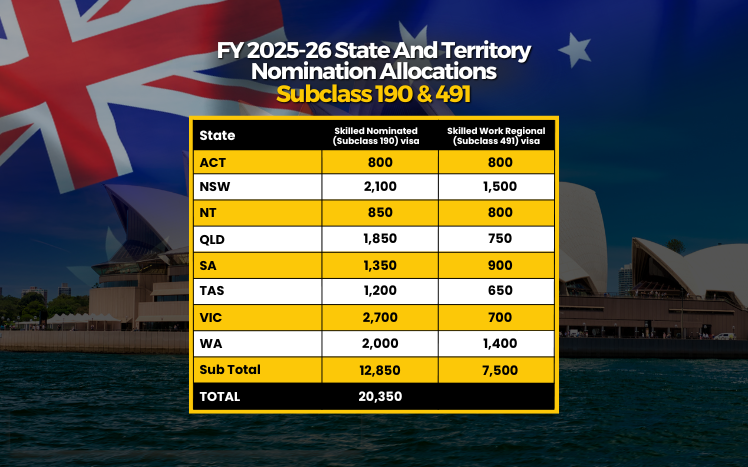
The Australian Department of Home Affairs has released the 2025–26 state and territory nomination allocations for the Skilled Nominated (Subclass 190) visa and the Skilled Work Regional (Subclass 491) visa. These allocations determine how many skilled migrants each state and territory can nominate for permanent and provisional residency pathways over the financial year.This year’s figures reveal a significant tightening across both visa subclasses, signaling increased competitiveness and more targeted migration strategies by state governments.

1. National Overview

For the 2025–26 program year, the total number of places allocated is:
Subclass 190: 12,850 places
Subclass 491: 7,500 places
Total: 20,350 places

This marks a notable reduction from the 2024–25 allocation, reflecting the government’s continued shift toward a smaller, more skilled, and more targeted migration program.

2. Subclass 190 – Skilled Nominated Visa

National Trend: Reduced Capacity
The 190 program has dropped from 16,500 places last year to 12,850 places in 2025–26, a reduction of 3,650 positions nationwide.
State-by-State Breakdown:
– ACT – 800
– NSW – 2,100
– NT – 850
– QLD – 1,850
– SA – 1,350
– TAS – 200
– VIC – 2,700
– WA – 2,000

Key Observations

  • Victoria (2,700 places) now holds the largest 190 allocation, overtaking NSW.
  • Western Australia continues an upward trend, reflecting demand in construction, engineering, and health.
  • NSW has experienced a significant reduction, likely leading to tougher selection criteria and higher competitiveness.
  • South Australia and Tasmania have seen sharp decreases, suggesting more targeted occupation lists and possibly prioritisation for onshore applicants

3. Subclass 491 – Skilled Work Regional Visa

National Trend: Moderate Decrease
The 491 program decreased from 9,760 places last year to 7,500 places for 2025–26.State-by-State Breakdown:
– ACT – 800
– NSW – 1,500
– NT – 800
– QLD – 750
– SA – 900
– TAS – 650
– VIC – 700
– WA – 1,400

Key Observations

– NSW remains the largest regional program, despite its reduction.
– Western Australia retains a strong focus on regional development, with 1,400 places.
– South Australia continues to prioritise regional migration with 900 allocations.
– States such as Queensland, Tasmania, and Victoria operate moderate-sized programs with selective criteria.

4. What These Changes Mean for Applicants

Higher Competition Across All States!

With reduced nomination numbers, states will become increasingly selective. Applicants with strong points, relevant work experience, and high English proficiency will be favoured.

Emphasis on Targeted Skills

States are expected to prioritise:
– Critical skill shortages
– Health, engineering, construction, and education sectors
– Applicants with strong employment evidence
– Onshore applicants with established ties

491 Remains an Important Pathway

While the 190 program has become more competitive, the 491 visa remains a valuable pathway for applicants willing to live and work in regional Australia.

5. Strategic Advice for 2025–26 Applicants

To remain competitive in the new migration landscape, applicants should consider:

5.1. Maximising Points
– Improve English scores
– Gain additional work experience
– Obtain partner skills points (if applicable)

5.2.⁠⁠ Building State/Territory Alignment
– Review each state’s occupation list and nomination criteria
– Strengthen ties such as employment, study, or community engagement
– Prepare compliant documentation early

5.3. ⁠⁠Considering Regional Pathways
With limited 190 places, regional options under the 491 visa may provide faster nomination opportunities, particularly in states like NSW, WA, and SA.

5.4. ⁠⁠Staying Updated
State nomination programs can change rapidly. Regular monitoring of updates ensures you do not miss closing windows or newly introduced priority occupations.

6.⁠⁠ Final Thoughts

The 2025–26 allocation signals a more targeted and strategic skilled migration program, with states focusing on applicants who can meet immediate labourmarket needs. While competition has increased, opportunities remain strong for applicants who prepare early, understand state priorities, and position themselves effectively.

For personalised advice on your best visa pathway under the 2025–26 program, contact our migration team —we’re here to help you navigate every step of the process.

Source: Allocations published on the Department of Home Affairs’websiteon 18 November 2025

November 17, 2025

Updated guidance and practical steps to secure employer sponsorship for Australia’s temporary and permanent employer-sponsored visas (subclass 482 / Skills in Demand and subclass 186 / ENS). Includes requirements, employer obligations, document checklists, processing tips and a comparison table.

Caveat: Australian migration rules change frequently. Always confirm final requirements on the Department of Home Affairs website and with a registered migration agent before lodging applications.

Quick summary (TL;DR)

· Subclass 482 (Skills in Demand) — temporary employer-sponsored visa for skilled workers; three main streams (short-term, medium-term, labour agreement). Employers nominate positions where suitably skilled Australians are not available.

· Subclass 186 (Employer Nomination Scheme, ENS) — permanent residency pathway for skilled workers nominated by an approved employer (streams: Temporary Residence Transition, Direct Entry, and Labour Agreement).

· How to secure sponsorship: find employer willing to sponsor → employer becomes approved sponsor → nomination lodged and approved → applicant lodges visa with evidence (skills, English, health, character). Detailed steps below.

Table: 482 vs 186

1. Understanding the visas

Subclass 482 — Skills in Demand
The Skills in Demand (subclass 482) visa permits employers to sponsor skilled workers where an Australian worker is not available. The visa has streams (short-term, medium-term and labour agreement) that determine duration, occupation lists and transition options to permanent residency. Employers must meet sponsorship obligations, nominate an occupation, and usually demonstrate labour market testing.

Subclass 186 — Employer Nomination Scheme
The ENS (subclass 186) grants permanent residency to skilled workers nominated by Australian employers. Streams include:
– Temporary Residence Transition (TRT): for existing 482 holders who have worked for the nominating employer for the required period.
– Direct Entry: for applicants who have not worked in Australia long enough but meet skills and experience criteria.
– Labour Agreement: where a labour agreement exists between employer and government.

2. Step-by-step: How to secure employer sponsorship

Step A — Job search and targeting sponsoring employers
– Focus on industries and occupations currently in demand (check the Medium and Long-Term Strategic Skills List and relevant state DAMA/designated area arrangements).
-Target employers who have sponsored before or advertise “willing to sponsor” roles. Use sector job boards and LinkedIn; approach recruiters with sponsorship experience.

Step B — Prepare a sponsorship-ready CV and evidence
– Tailor CV to the ANZSCO occupation description.
– Compile certified copies of qualifications, employment references (with start/end dates, duties, hours/week), and registration licences where required.
– English test results if already available (IELTS, PTE, OET etc.).
– Keep police checks and passport pages ready.

Step C — Employer becomes an approved sponsor
– Employer lodges an application to become an approved standard business sponsor and meet obligations (show legal operation, training requirements, workforce composition). This step can take time and requires genuine business documentation.

Step D — Employer nomination for the role
– Employer lodges the nomination specifying the role, salary, location, and that labour market testing was performed (where required).
– Nomination must satisfy the Department that the position is genuine, market-rate salary is offered (meet the Temporary Skilled Migration Income Threshold or (ASMR) as applicable), and that the employer meets training obligations or alternatives.

Step E — Applicant lodges the visa application
– Once nomination approved, lodge visa with supporting documents: identity, skills assessment (if required), employment evidence, English, health and character checks, and any applicant-specific requirements for the chosen stream.

3. Employer obligations and best practices

– Maintain a genuine position and employment contract.
– Comply with sponsorship obligations: keep records, notify Home Affairs of changes, ensure workplace conditions meet Australian law and the nominated terms.
– Meet training benchmarks or evidence of contribution to local skill development (some sponsors must show investment into Australian workforce training).

4. Applicant requirements — checklist

Common documents and requirements
– Valid passport and ID pages.
– Evidence of qualifications (degrees, transcripts), certified and translated if needed.
– Employment references detailing role, duties, hours, and dates.
– Skills assessment for Direct Entry 186 or where listed as required.
– English language evidence (IELTS/PTE/OET) depending on stream and occupation.
– Health examination results (as requested).
– Police certificates.
– Evidence of relationship/dependants (if family included).
– Evidence employer provided labour market testing and contract.

5. Processing times & practical timing

Processing times vary by stream, occupation and current caseload. ENS (186) processing can be lengthy; allow several months to over a year in some categories — employers should plan ahead. Temporary 482 processing times also vary; plan early and lodge complete applications to avoid delays. Recent reporting suggests extended ENS processing times for certain streams — confirm current estimates on Home Affairs and visa processing dashboards.

6. Common pitfalls and how to avoid them

– Incomplete evidence: missing or vague employment references cause delays or refusals—provide precise dates, duties, and hours.
– Salary below market: ensure salary meets Department thresholds (ASMR/TTS).
– Poorly described occupation: align role to correct ANZSCO code and provide a strong position description.
– Late sponsor approval: employers must be approved sponsors before nomination—start employer paperwork early.
– Assuming all 482 streams lead to PR: transition options depend on stream and time with employer—confirm pathway for chosen occupation/stream.

7. Tips for candidates to become more attractive to sponsors

– Obtain recognized certifications, licences and positive referees in target industry.
– Show flexibility (regional willingness increases employer interest and can open pathways via DAMA/designated area arrangements).
– Build a proven record of performance (projects, KPIs, measurable achievements).
– Understand employer needs and prepare a tailored pitch showing immediate value.

8. Evidence checklist employers should collect (for nomination)

– Business registration and ABN documents.
– Financial statements to show ability to pay the nominated salary.
– Evidence of recruitment/labour market testing (ads, dates, responses).
– Position description and employment contract.
– Training/workforce development evidence or plan.
– Past sponsorship history (if any)

9. Regional and state variations

Some regions and states have Designated Area Migration Agreements (DAMA) or special regional lists offering tailored occupation lists and concessions. Check state government pages if an employer operates in a designated area. Regional roles often have increased chances for sponsorship and sometimes different English/salary requirements.

10. FAQs

Q: Can a 482 visa holder apply for permanent residency?
A: Yes — certain medium-term 482 holders and those meeting TRT criteria can transition to subclass 186 or other PR pathways, depending on employer and time employed. Check stream conditions carefully.

Q: How long does an employer take to become an approved sponsor?
A: Approval time varies. Gather business documentation early and ensure compliance with sponsorship obligations to avoid delays.

Q: Do sponsors pay a fee?
A: Yes — there are sponsor approval and nomination fees, and employers must meet obligations such as training benchmarks. Applicants also pay visa application charges. Check Home Affairs fee schedule.

11. Final practical checklist (quick)

1. Identify target occupation and confirm ANZSCO code.
2. Research whether the occupation is on the applicable list (MLTSSL/STSOL or DAMA lists).
3. Prepare certified documents (qualifications, references, English).
4. Approach employers with sponsorship capability; present tailored value proposition.
5. Employer seeks sponsor approval (if required) → lodges nomination → applicant lodges visa.
6. Complete health and police checks promptly.
7. Monitor processing times; maintain communication with employer and migration advisor.

November 11, 2025

The Australian Department of Home Affairs has announced a significant update regarding the processing of offshore Student Visa (Subclass 500) applications.
Effective 14 November 2025, Ministerial Direction 115 (MD 115) will revoke and replace Ministerial Direction 111 (MD 111). This new direction introduces a three-tier priority system to ensure a more structured and efficient approach to student visa processing.

Overview of Ministerial Direction 115

Ministerial Direction 115 outlines how the Department will prioritise offshore student visa applications. The priority level is determined at the time of lodgement and does not influence the visa outcome. Instead, it affects how quickly the application will begin processing.


Priority 1 – Highest Priority (Processing Commences Within 1 to 4 Weeks)

The highest priority will be given to applications from:

  • School students
  • Non-award sector students, including short-term exchange students
  • Standalone ELICOS students
  • Students enrolled with a TAFE provider (including identified TAFE courses at Charles Darwin University)
  • Students enrolled in recognised pilot training courses
  • Postgraduate research (PhD) students
  • Students sponsored by the Department of Foreign Affairs and Trade (DFAT) or the Department of Defence
  • Students receiving foreign or Australian government scholarships
  • Transnational education students
  • Students from the Pacific and Timor-Leste
  • Subsequent entrants where the application includes a minor (a child under 18 years of age)

Priority 2 – Moderate Priority (Processing Commences Within 5 to 8 Weeks)

Applications in this category include:

  • Higher Education and Vocational Education and Training (VET) students whose education providers have reached 80% of their New Overseas Student Commencement (NOSC) allocation in 2025
  • Subsequent entrants without a minor

Priority 3 – Lowest Priority (Processing Commences Within 9 to 12 Weeks)

This category applies to:

  • Higher Education and VET students whose providers have exceeded their NOSC allocation by 15% or more

Implementation Details

  • Ministerial Direction 115 applies to all offshore Student Visa (Subclass 500) applications lodged on or after 14 November 2025.
  • Ministerial Direction 111 will continue to apply to any offshore Student Visa (Subclass 500) lodged and not finally determined before 14 November 2025.

Applicants and education providers are encouraged to review the full Ministerial Direction on the Department of Home Affairs website for more detailed information, including how packaged courses will be assessed under the new framework.


How EMK Global Can Help

At EMK Global, we specialise in providing expert guidance for students aspiring to study in Australia. Our experienced team helps applicants understand eligibility requirements, prepare complete documentation, and submit strong visa applications in line with the latest government directions.

If you are planning to apply for a Student Visa (Subclass 500) from overseas, our consultants can assist you with every step of the process.

Contact EMK Global today to book a consultation and receive up-to-date support for your Australian student visa journey.

November 4, 2025

Fresh Interim Allocation & Updated Priority Attributes Announced 

The Tasmanian Government has released a significant November 2025 update to its Skilled Migration State Nomination Program. While the Australian Government is yet to confirm the full annual quota for 2025–26, Tasmania has received an additional interim allocation of 450 nomination places, opening new doors for skilled professionals and graduates seeking permanent residency in Australia. 

This update ensures that Tasmania continues to attract qualified migrants who can contribute to the state’s growing industries, particularly in construction, healthcare, education, and regional development. 

New Interim Allocation for November 2025

Visa Subclass Number of Places (Nov 2025 Interim) Purpose 
Subclass 190 – Skilled Nominated Visa 300 Permanent residency pathway for skilled workers nominated by Tasmania 
Subclass 491 – Skilled Work Regional (Provisional) 150 Temporary regional visa leading to PR after 3 years of residence and work 

This additional 450 places will allow the state to resume weekly invitation rounds, with invitations expected to be issued across all Gold, Green, and Orange Pass categories. 

Weekly updates will be posted on the official Migration Tasmania website, detailing: 

  • Number of ROIs (Registrations of Interest) invited 
  • Lowest scores invited 
  • Nomination places available 
  • ROIs currently on hand 

Tasmania’s final allocation for the 2025–26 migration year will be confirmed in the coming weeks. 

Comparison: 2024–25 vs 2025–26 (Interim)

Program Year Total Allocation Subclass 190 Subclass 491 Invitation Frequency Key Notes 
2024–25 2,300 1,350 950 Monthly Rounds Full-year confirmed quota 
2025–26 (Interim) 450 300 150 Weekly Rounds Awaiting full quota confirmation 

Key Difference: 
While the interim allocation is smaller than 2024–25, weekly rounds mean faster processing and more consistent invitations for eligible candidates. 

Key Clarifications from Migration Tasmania

Claiming Multiple Priority Attributes

Residency-Based Priority Attributes
Example: 
– If you’ve lived in Tasmania for four years, you can only claim the attribute: 
– “You have lived in Tasmania continuously for at least four but less than five years.” 
– You cannot claim shorter-duration attributes (such as 3–4 years). 

Choosing the Right Pathway
If you qualify under multiple migration pathways (e.g., Skilled Graduate and Established Resident), submit an ROI under the pathway with the highest attribute score
Migration Tasmania does not prioritize one pathway over another — invitations are purely score-based

Website Updates & Policy Clarifications (November 2025)
Migration Tasmania recently updated several nomination requirements to ensure clarity and fairness across all pathways. 

Tasmanian Skilled Graduate Pathway – Subclass 190

Criteria 2024 Requirement 2025 Update 
Minimum residence while studying 1 year 2 years 
Qualification level Cert III or higher Cert III or higher 
Work experience requirement Not mandatory Not mandatory 

Tasmanian Established Resident Pathway 

Applicants who have worked for at least 6 months in a role directly related to their skills assessment or Tasmanian study can now claim the priority attribute, even if their income is below the salary threshold. 

Criteria Requirement 
Minimum Employment Period 6 months 
Income Threshold Below $57,000/year or $28.85/hour 
Qualification Certificate III or higher 
Correction The earlier 12-month limit has been removed 

Employment Not Related to Skills Assessment – Updated Attribute

Employment Duration Salary Requirement Attribute Eligibility 
3–9 months $57,000/year or $28.85/hr ✅ Eligible 
9 months–2 years Same threshold ✅ Higher-Scoring Attribute 
Over 2 years Not applicable ❌ Not claimable 

This ensures fairer scoring for all candidates and rewards consistent employment in Tasmania. 

Why This Update Matters 

The November 2025 update highlights Tasmania’s continued efforts to streamline migration pathways, particularly for: 

  • Onshore international graduates 
  • Skilled professionals in high-demand sectors 
  • Regional residents contributing to Tasmania’s workforce 

These updates align with the state’s broader goal to attract long-term residents who can fill critical skill shortages and contribute to Tasmania’s economic development. 

Key Takeaways 

  • Tasmania adds 450 interim nomination places (300 for Subclass 190, 150 for Subclass 491). 
  • Weekly invitation rounds across Gold, Green, and Orange Passes
  • Updated priority attributes for both skilled and established residents. 
  • Clearer eligibility for work experience and residency duration. 
  • 2-year minimum study period for the Tasmanian Skilled Graduate Pathway (Subclass 190). 

Final Thoughts 

Tasmania’s 2025–26 Skilled Migration Program update offers a transparent and accessible PR pathway for skilled professionals, international graduates, and regional workers. 

 With weekly invitationsclear scoring rules, and expanded eligibility for local employment, this interim allocation strengthens Tasmania’s position as one of the most welcoming and progressive states for skilled migration in Australia.